The Net-zero Carbon Home

Introduction

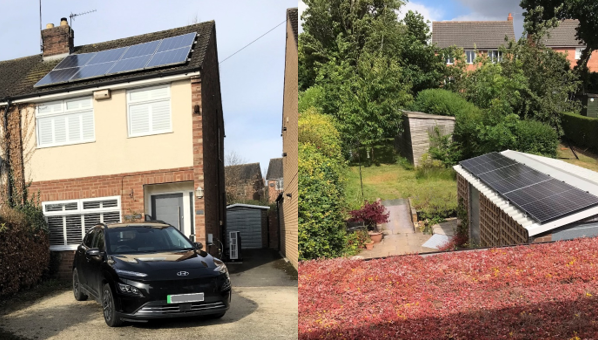
In 2010, I decided to begin making the transition from business-as-usual to a low-carbon, sustainable existence, to try to mitigate my personal contribution to climate change, to be part of the solution and one less part of the problem. This case-study documents what can be achieved in an average UK 1960’s three-bedroom semi-detached house, with a modern but low-impact lifestyle. What follows is a summary of what has been achieved through the activities which can be influenced individually from 2010 to 2024, the second successive year in which Net-zero Carbon was achieved. The full time-line diary with more detail can be viewed in the accompanying text ‘The Road to Carbon-zero,’ on the right-side menu.

Overall, by 2024 total carbon emissions have been reduced by 79% or 8.5 tCO2e per year compared to the 1998 baseline year, from 10.7 tCO2e to 2.2 tCO2e. For context, this is less than a 2030 global per-capita footprint target aligned with the Paris Agreement somewhere in the region of 2.3 tCO2e (WWF, 2023). Furthermore, personally controllable emissions, omitting infrastructure, produced a carbon negative figure of -0.5 tCO2e per year. The chart in Fig.1. shows the carbon emissions reduction over the period, comparing the total footprint, personally controllable emissions, and the UK per capita target according to The World-Wide Fund for Nature (WWF) carbon footprint calculator. This calculator also suggests the average carbon footprint for my area is 11.3 tCO2e per person.

(Note: The methods used here are just one interpretation of calculating CO2 emissions, it is not exhaustive, it is a general simplification for illustrative purposes).
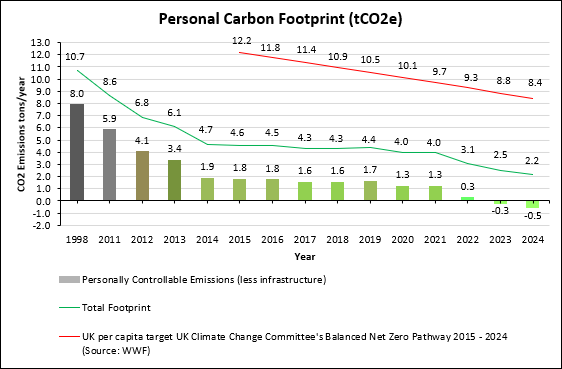
Fig.1. The footprint of Annual CO2e emissions from 2011 to 2024, and including the 1998 baseline.

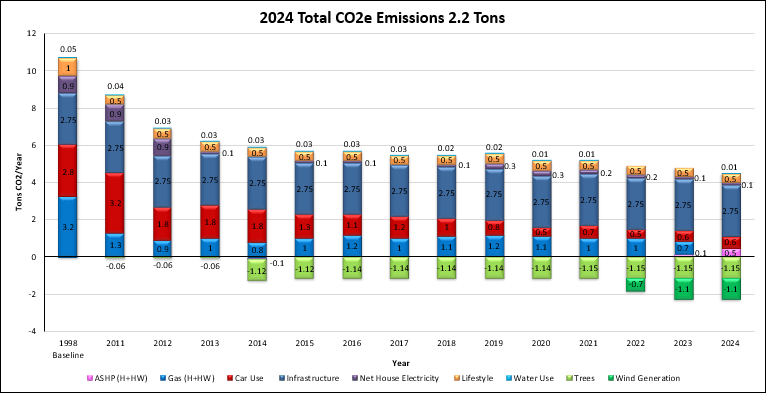
The chart in Fig.2. shows the Carbon Fingerprint, which shows the emission impact over the period from the individual activities which can be targeted for reduction.
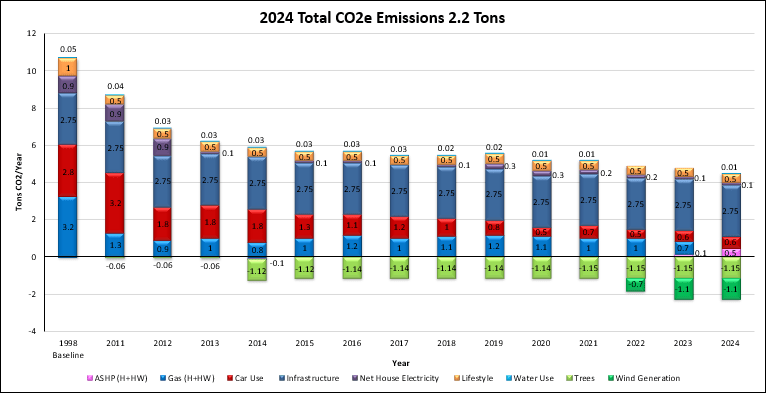
Fig.2. The fingerprint of Annual CO2e emissions from 2011 to 2024, and including the 1998 baseline. (Note: Car Use is electric from 2015 – 2024).

Summary of Impacts – 2024 compared to 1998 Baseline year

Annual Household Grid Electricity Energy Consumption reduced by 34%, emissions reduced by 0.8 tCO2e/Year, through efficiency and solar power used on-site and exported to the National Grid. Energy storage battery provides load shifting from peak-time to off-peak.

Annual Space and Water Heating Energy Consumption reduced by 84%, emissions reduced by 2.7 tCO2e/Year, through insulation, improved glazing, and more efficient heat sources, initially gas condensing boiler then Air Source Heat Pump.

Annual Car Travel emissions reduced by 79% or 2.2 tCO2e/Year through switching from Internal Combustion Engine to Battery Electric power, despite an average increase in mileage of 4000 mile/Year.

Annual Water Consumption reduced by 80%, emissions reduced by 0.04 tCO2e/Year through water harvesting, water efficient appliances, and only using a shower.

Annual Lifestyle emissions reduced by 50% or 0.5 tCO2e/Year through low consumption lifestyle, local and sustainably sourced organic food, a vegan diet, support for several environmental charities, and sustainable, ethical finances.

Annual Infrastructure emissions remain stable for UK citizens at 2.75 tCO2e/Year but personally Offset by 42% or 1.15 tCO2e/Year, through natural sequestration by tree planting.

Renewable power generation from a share in the Ripple Energy Graig Fatha Wind Turbine project, the UK’s first consumer-owned renewable energy generation source, displaces fossil-fuel generated emissions from the National Grid. In 2024, this removed 1.1 tCO2e emissions providing off-set for 92% of emissions from my grid electricity use. 

Current Specifications

  • 2.8 kWp Solar power generation
  • Tesla Powerwall 3, 13.5 kWh Electrical energy storage battery (Lithium Iron Phosphate). 
  • Efficient A-rated electrical appliances
  • LED lighting in 100% of outlets
  • 100% green energy supplier Octopus Energy
  • Time-of-use (ToU) electricity tariff (5hrs super cheap off-peak night rate)
  • Electrical energy monitoring system (OpenEnergyMonitor)
  • Renewable power generation from a share in the Ripple Energy Graig Fatha Wind Turbine project.
  • 300 mm Wool Fibre Loft Insulation, Cavity wall insulation, Insulated Front door (no letterbox), Insulated flat roof.
  • Double glazed windows, A-rated, argon-filled, with a low emissivity coating.
  • Plantation Shutters on South-East windows.
  • Main Space & Water Heating –5 kW Mitsubishi Ecodan Air-source Heat Pump.
  • Electric Vehicle (350-mile range on one full charge), with smart charging point at the dwelling (can charge on super off-peak rate and solar power).
  • Water harvesting and Sustainable drainage system (SuDS) on driveway.
  • Biodiversity enhancement through an annual donation to the Woodland Trust to plant 25 m2 of woodland, 14 native trees planted on-site, two ponds created, a green wall, and an Extensive Sedum Green Roof on flat roof extension.

Supporting Environmental Charities

Green Financing

Referral Codes

Octopus Energy Referral code worth £50,  https://share.octopus.energy/oak-moose-437

Ripple Energy Referral code worth £25, https://rippleenergy.com?ogu=319&rtrfn=Paul-M

In Collaboration with –

The author is a graduate of both The Open University and The Centre for Alternative Technology, and co-founder and a director of The Electric Vehicle Association in Wales EVA Cymru, a non-profit organisation. This Net-zero carbon home is part of the National Energy Foundation SuperHomes Network, and has been used as a case study in course materials for The Open University in 2024.

References

WWF, 2025. Footprint Calculator. Available at: https://footprint.wwf.org.uk/ (Accessed 16 January 2025).

WWF, 2023. Footprint Calculator Report. Available at: https://www.wwf.org.uk/our-reports/footprint-calculator-report-2023 (Accessed 16 January 2025).
The Road to Carbon-Zero 2024  – First Full Year Fossil-Fuel Free & Battery Upgrade

Introduction

This year marked the first full year where no fossil-fuel was used directly to power and heat the dwelling, and fuel car travel. In November, the electrical energy storage battery was replaced and upgraded to a Tesla Powerwall 3 with 13.5 kWh of storage capacity. This will provide stored off-peak electricity and solar generation to power and heat the home throughout the day, even in mid-winter, and will eliminate grid electricity use in mid-summer. Total emissions were again reduced further and personally controllable emissions remained negative at -0.5 tCO2e, importantly in a year when global carbon emissions were recorded to have risen again according to the UK Met Office. The carbon fingerprint is shown in Fig.1. in comparison with previous years and baseline.

Fig.1. The fingerprint of CO2e emissions in 2024, in comparison with previous years and baseline.

Solar Power Generation

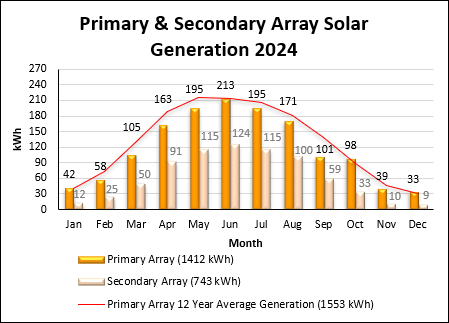
The total solar power generation for the year decreased by 228 kWh to 2155 kWh, derived from reading the generation meters. The primary array data shows that solar irradiance was much lower this year than the 12-year average across the entire year. The monthly solar generation data are shown in Fig.2.

Fig.2. Monthly solar generation data.

Wind Power Generation

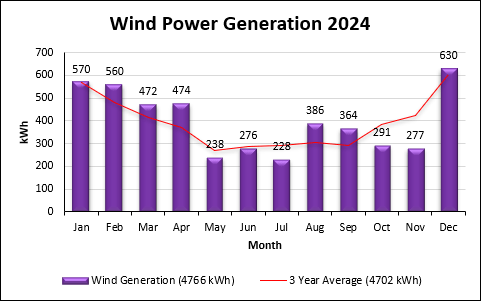
The total wind power generation from my ownership share in the Graig Fatha turbine for this year was 4766 kWh, displacing this amount of conventional grid electricity generation with carbon intensity of 0.225 kgCO2e/kWh (DECC, 2024) for a 2024 generation mix. This resulted in an emission off-set of 1072 kgCO2e or 1.1 tCO2e. The monthly wind generation data were derived from my personal Ripple dashboard, and are shown in Fig.3.

Fig.3. Monthly wind power generation data.

Household Electricity Consumption

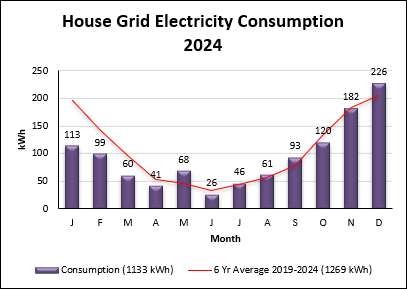
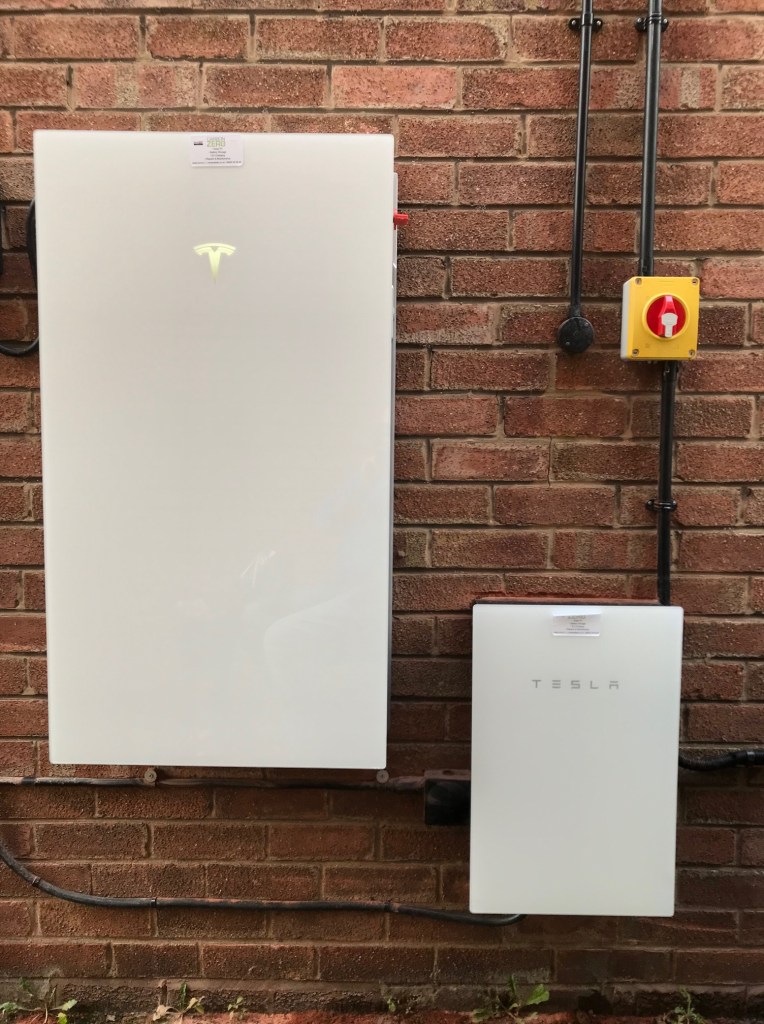
Total annual household electricity grid consumption was reduced on the previous year by 44 kWh or 4% to 1133 kWh, again derived from reading the electricity meter. Consumption was again well below the six-year average, due mainly to the secondary solar array, but also partly to the reduced storage capacity of the battery during the winter months early in the year. The higher storage capacity of the new battery (pictured in Fig.5.) shows increased consumption in the last two months. The higher-than-average consumption in May, August and September corresponds with the very poor solar irradiance in these three months. The monthly grid electricity consumption data are shown in Fig.4.

Fig.4. Monthly household grid electricity consumption data.

The Tesla Powerwall 3 Electrical Energy Storage Battery has a storage capacity of 13.5 kWh and a power delivery of 11 kW, facilitating coverage of any power use in the property without the use of the grid during peak hours. The system can also work seamlessly in isolation from the grid during a power outage using a gateway. The improved battery chemistry of Lithium Iron Phosphate (LFP) is more sustainable in production, has increased longevity, and can work within greater temperature extremes, and is a significant upgrade.

Fig.5. The 13.5 kWh Tesla Powerwall 3 Electrical Energy Storage Battery and gateway.

The assumption was made that only 25% of solar generation was exported, and 75% was consumed on-site, inferred from monitoring system data. Therefore, 1133 kWh grid consumption minus 539 kWh solar export resulted in a net grid electricity consumption of 594 kWh. Grid electricity was given a carbon intensity figure of 0.225 kgCO2e/kWh (DECC, 2024) for a 2024 generation mix. The combined solar self-consumption and exported generation resulted in emissions remaining stable at 134 kgCO2e or 0.1 tCO2e.

Space and Water Heating

Space heating and water heating was provided by the Mitsubishi Ecodan 5 kW Air-source heat pump (ASHP) for the first full year. The ASHP consumed a total of 2464 kWh of electricity, with 2118 kWh from the grid and the difference supplied by solar power, derived from both a meter and the heating controller, and was given a carbon intensity figure of 0.225 kgCO2e/kWh (DECC, 2024) for a 2024 generation mix. This resulted in 477 kgCO2e or 0.5 tCO2e emissions, approximately half the annual emissions of the gas combi boiler whilst providing more than double the heat and more constant thermal comfort. Importantly, the electrical consumption produced 11056 kWh of heat, giving a coefficient of performance (COP) of 4.01. Essentially, every unit of electrical input delivers 4 units of heat, an efficiency of 400%. For context, a new gas boiler has a real-world efficiency of around 90%, which would only deliver 4675 kWh of heat based on the 10-year average gas consumption in this case. The monthly consumption data is shown in comparison with gas in Fig.6.

Fig.6. Monthly Space & water heating electricity consumption data.

Car Travel

The car in use was a battery electric vehicle (BEV) Hyundai Kona 64-kWh. The annual mileage estimated to the nearest 1000 increased to 13000 miles, or 20500 km. The car was charged in part directly from the solar arrays, and 184 kWh was delivered this way equating to approximately 1200 km. This meant grid consumption was reduced, providing 19300 km of travel. As the fuel is electricity, the carbon intensity figure of fuel production and use in an electric vehicle is the same as is given for grid electricity, which this year was 0.225 kgCO2e/kWh (DECC, 2024) for a 2024 generation mix. The car consumed 2880 kWh of electricity to charge, derived from monthly readings of the night time consumption meter and shown as a column chart in Fig.7., resulting in fuel production emissions only increasing to 615 kgCO2e or 0.6 tCO2e.

Note: In the units previously given for vehicle emissions, 2024 grid electricity equates to 0.03 kgCO2e/km.

Fig.7. Monthly car charging data. (Note: 9-year average excludes 2020 due to pandemic lock-down anomaly).

Water Consumption

Total annual household water consumption increased to 19 m3, derived from a utility bill for that year. The 2024 carbon intensity figure of domestic water supply (0.153 kgCO2e/m3), and treatment (0.186 kgCO2e/m3) is given as 0.339 kgCO2e/m3 (DECC, 2024). This resulted in a 50% increase of 2 kgCO2e to 6 kgCO2e or 0.01 tCO2e emissions. The reason for this increased consumption is not known, and therefore could highlight a potential underground leak or meter issue which is under investigation.

Lifestyle

There were no changes regarding lifestyle in this year, so there was no effect to the results for lifestyle in the carbon footprint calculator (WWF, 2024), and emissions remained at 0.5 tCO2.

Infrastructure

The figure for infrastructure emissions from the carbon footprint calculator remained at 2.75 tCO2 for each UK citizen. The annual donation to the Woodland Trust to plant 25 m2 of woodland, the 14 trees planted, and the green roof and wall off-set and sequester -1.15 tCO2 of these indirect emissions.

Behaviours

There were no behavioural changes in this year, but all previous behavioural changes were maintained. However, the increased storage capacity and power output of the new battery will facilitate more flexibility in electrical power use, for example being able to run several high output appliances at the same time without grid input, if circumstances require it. Previously, this was avoided unless absolutely necessary.

Conclusions

Overall, emissions decreased compared to the previous year by 12% or 0.3 tCO2e, resulting in 79% or 8.5 tCO2e lower annual emissions compared to the baseline year. The ASHP accounted for the decrease, replacing gas for space and water heating, on average halving emissions from this sector. Wind power generation off-set 92% of electricity grid consumption for the home, travel, and space and water heating. This is a great result, considering the share in the wind turbine was matched to provide the consumption of the home and car, but is now also providing most of the heating consumption to.

References

The Department for Energy and Climate Change (2024). Greenhouse gas reporting – Conversion factors 2024. Available at: https://www.gov.uk/government/publications/greenhouse-gas-reporting-conversion-factors-2024 (Accessed 14 January 2025).

WWF, 2025. Footprint Calculator. Available at: https://footprint.wwf.org.uk/ (Accessed 16 January 2025).
The Road to Carbon-Zero 2022 – Net-zero for Electricity use

Overview

In March, the Ripple Energy Graig Fatha Wind Turbine project, the UK’s first consumer-owned renewable energy generation source, came on-line and began generating zero-carbon electricity. In addition, in July a new 1 kWp secondary solar array was installed on the south-west facing roof of the garage, and the car charging point on the side of the house was replaced with a ‘smarter’ device which enables the car to charge directly from solar generation with no grid input. These measures resulted in net-zero emissions for total electricity use for the first time. The carbon fingerprint is shown in Fig.1. in comparison with previous years and baseline.

Fig.1. The fingerprint of CO2e emissions in 2022, in comparison with previous years and baseline.

Solar Power Generation

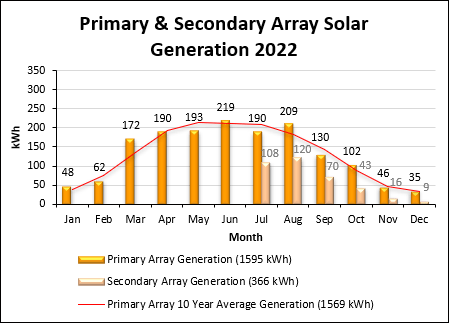
The total solar power generation for the year increased by 449 kWh to 1961 kWh, mainly due to the new 1 kW secondary array shown in Fig.3., but also higher solar irradiance. Data were derived from reading the generation meters. The monthly solar generation data are shown in Fig.2.

Fig.2. Monthly solar generation data.

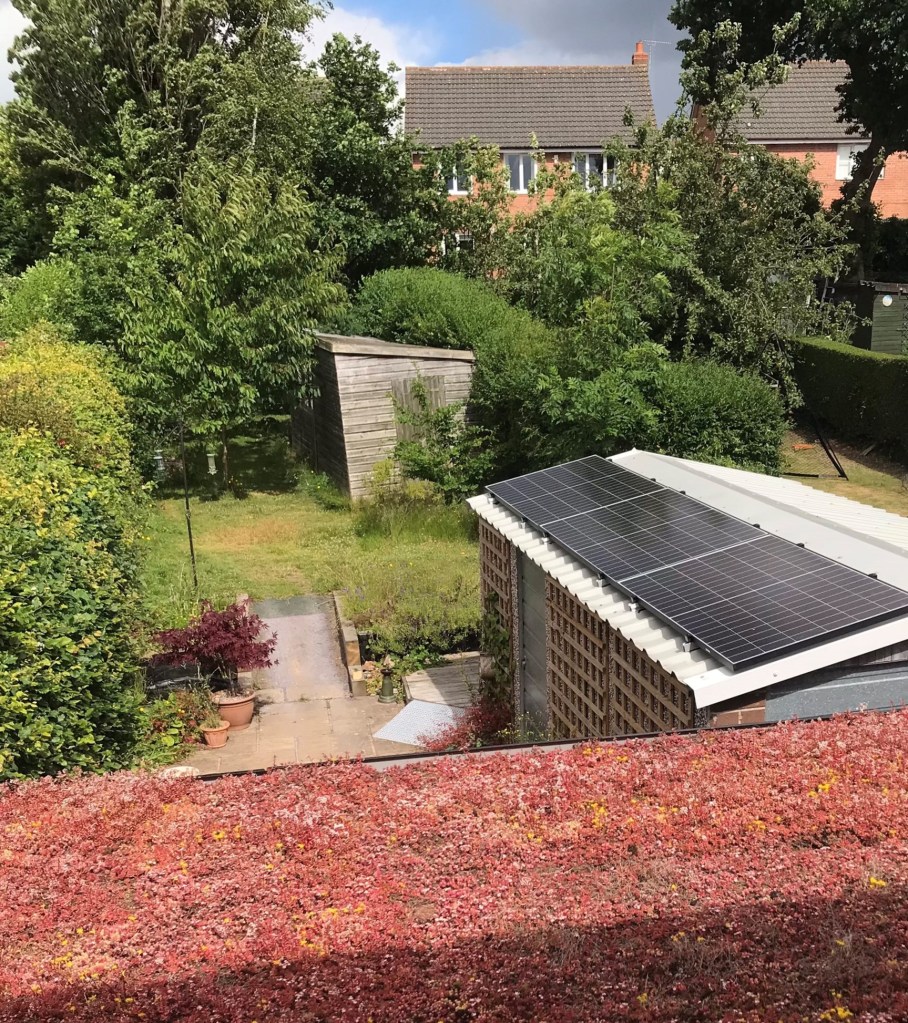
Fig.3. The secondary 1 kWp solar array on the south-west facing garage roof. Maturing planted trees and green roof are also in view.

Wind Power Generation

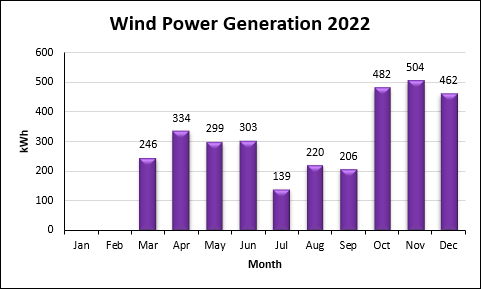
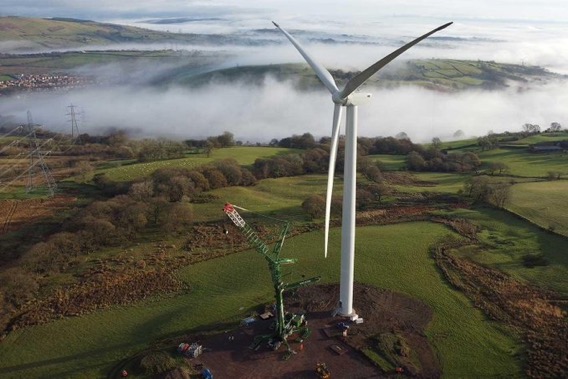
The total wind power generation from my ownership share in the Graig Fatha turbine (Fig.5.), for this part-year was 3195 kWh, displacing this amount of conventional grid electricity generation with carbon intensity of 0.211 kgCO2e/kWh (DECC, 2022) for a 2022 generation mix. This resulted in an emission off-set of 674 kgCO2e or 0.7 tCO2e. The monthly wind generation data were derived from my personal Ripple dashboard, and are shown in Fig.4.

Fig.4. Monthly wind power generation data.

Fig.5. Graig Fatha, consumer-owned 2 Mega-Watt wind turbine. (Photo source: Ripple Energy)

Household Electricity Consumption

Total annual household electricity grid consumption was reduced on the previous year by 36 kWh or 3% to 1200 kWh, again derived from reading the electricity meter. The monthly grid electricity consumption data are shown in Fig.6.

Fig.6. Monthly grid electricity consumption data.

The assumption was made that only 25% of solar generation was exported, and 75% was consumed on-site. Therefore, 1200 kWh grid consumption minus 490 kWh solar export resulted in a net grid electricity consumption of 710 kWh. Grid electricity was given a carbon intensity figure of 0.211 kgCO2e/kWh (DECC, 2022) for a 2022 generation mix. The combined solar self-consumption and exported generation resulted in an emission decrease of 48 kgCO2e to 150 kgCO2e or 0.2 tCO2e.

Space and Water Heating

Total annual household gas consumption decreased by 3% on the previous year to 4926 kWh, derived from monthly meter readings, shown as a column chart in Fig.7. All consumption was provided by the gas grid, and given a carbon intensity figure of 0.2 kgCO2e/kWh (DECC, 2022). This resulted in a decrease of 45kgCO2e to 985 kgCO2e, stabilising emissions at 1.0 tCO2e.

Fig.7. Monthly gas consumption data.

Car Travel

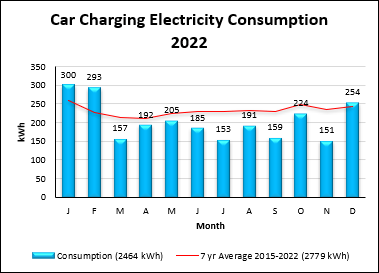
The car in use was a battery electric vehicle (BEV). The annual mileage estimated to the nearest 1000 decreased on the previous year to 12000 miles, or 19000 km. As the fuel is electricity, the carbon intensity figure of fuel production and use in an electric vehicle is the same as is given for grid electricity, which this year was 0.211 kgCO2e/kWh (DECC, 2022) for a 2022 generation mix. The car consumed 2464 kWh of electricity to charge, derived from monthly readings of the night time consumption meter and shown as a column chart in Fig.8., resulting in a decrease in fuel production emissions only to 520 kgCO2e or 0.5 tCO2e.

Note: In the units previously given for vehicle emissions, 2022 grid electricity equates to 0.027 kgCO2e/km.

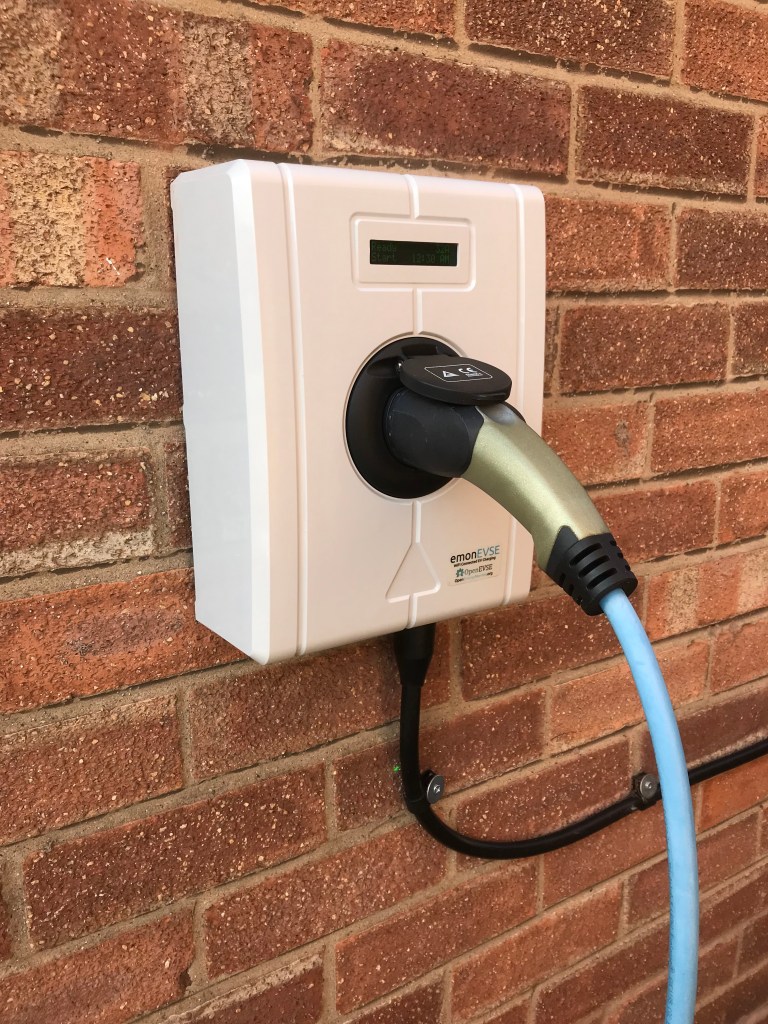
The new charging device, shown in Fig.9., was supplied by the same company that produce the energy monitoring system, OpenEnergyMonitor, therefore enabling the two devices to talk to each other, and allowing charging to start and stop with changes in solar generation.

Fig.8. Monthly car charging data. (Note: 7-year average excludes 2020 due to pandemic lock-down anomaly).

Fig.9. The smart car charging point by OpenEnergyMonitor on the side of the house.

Water Consumption

Total annual household water consumption was reduced to 10 m3, derived from a utility bill for that year. The 2022 carbon intensity figure of domestic water supply (0.149 kgCO2e/m3), and treatment (0.272 kgCO2e/m3) is given as 0.421 kgCO2e/m3 (DECC, 2022). This resulted in a 20% reduction of 1 kgCO2e to 4 kgCO2e or 0.0 tCO2e emissions.

Adapting to Climate Change Update

On 18 July, a new provisional national temperature record for Wales of 37.1°C was recorded at Hawarden Airport, Flintshire, just three miles from my home. At 2pm the sun was overhead, beaming down on the green roof, and the outside shade temperature peaked at 36.1 oC. The air temperature beneath the green roof was 11 oC cooler than the outside shade, and the inside temperature remained bearable and peaked at 24.9 oC. Furthermore, a bare rubber flat roof in full sun would be more like 60 oC rather than the 36 oC shade temperature.

There is no doubt that the combined measures of loft and cavity wall insulation, A-rated double glazing, green roof, and shutters kept the inside space comfortable in the face of extreme heat. Importantly, no extra energy was used or needed to cool the internal space.

Lifestyle

There were no changes regarding lifestyle in this year, so there was no effect to the results for lifestyle in the carbon footprint calculator (WWF, 2022), and emissions remained at 0.5 tCO2.

Infrastructure

The figure for infrastructure emissions in the carbon footprint calculator (WWF, 2016) remained at 2.75 tCO2 for each UK citizen. The annual donation to the Woodland Trust to plant 25 m2 of woodland, the 14 trees planted, and the green roof and wall off-set and sequester -1.15 tCO2 of these indirect emissions.

Behaviours

The addition of wind generation, second solar array, and smart car charging allowed further behavioural change around electricity use, maximising zero-carbon sources. The additional solar array would enable the car to be charged during the day using peak solar generation in the summer months in the following year. The wind power generation allowed overnight car and house battery charging when the turbine was generating, and a four-day ahead forecast enabled the amount of charging to be increased or decreased accordingly.

Conclusions

Overall, emissions decreased compared to the previous year by 23% or 0.9 tCO2e, resulting in 71% or 7.6 tCO2e lower emissions compared to the baseline year. A reduction in travel mileage accounted for 0.2 tCO2eof the decrease, however the remaining 0.7tCO2e came from wind power generation. In fact, this completely off-set all electricity grid consumption for both the home and travel, and emissions from water consumption were also eliminated, both for the first time in this year.

References

The Department for Energy and Climate Change (2022). Greenhouse gas reporting – Conversion factors 2022. Available at: Greenhouse gas reporting: conversion factors 2022 – GOV.UK (www.gov.uk) (accessed 17th December 2023).

WWF-UK (2021). Available at: WWF Footprint Calculator (accessed January 2023).

The Road to Carbon-Zero 2020 – EV Upgrade, Energy Monitoring, and Covid Impact.

Overview

At the end of 2019, the Nissan Leaf was replaced with another battery electric vehicle (BEV), the BMWi3. This BEV had a 42-kWh battery and was lighter and more efficient, which increased the driving range from 90 miles to 240 miles on a single full charge. At the beginning of the year, an energy monitoring system from OpenEnergyMonitor was installed to see the electricity consumption and solar generation in real time to optimise efficiency and further reduce energy cost, grid electricity consumption, and carbon emissions. The Covid-19 pandemic ‘lock-downs’ also had some impact on consumption patterns. The carbon fingerprint is shown in Fig.1. in comparison with previous years and baseline.

Fig.1. The fingerprint of CO2e emissions in 2020, in comparison with previous years and baseline.

Solar Power Generation

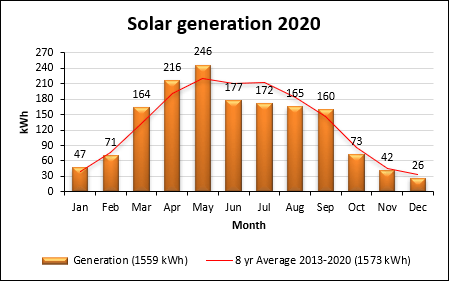
The total solar power generation for the year decreased slightly by just 4 kWh to 1559 kWh, derived from reading the generation meter. The monthly solar generation data are shown in Fig.2. Whilst annual generation remained close to the eight-year average, monthly generation showed some unusual variation.

Fig.2. Monthly solar generation data.

Household Electricity Consumption

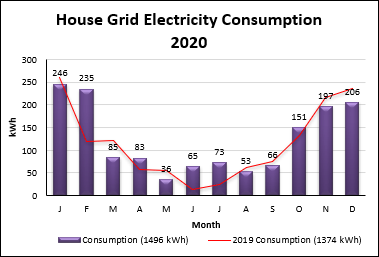
Total annual household electricity grid consumption increased on the previous year by 122 kWh or 9% to 1496 kWh, again derived from reading the electricity meter. This increase was mainly due to the replacement of the combi-boiler fed shower with an electric version. The monthly grid electricity consumption data are shown in Fig.3., in comparison to the previous year’s consumption, being the first complete data set with the battery system. This highlights the increased grid consumption in June and July due to cloudy conditions reducing solar generation.

Fig.3. Monthly grid electricity consumption data.

The assumption was made that only 25% of solar generation was exported, and 75% was consumed on-site. Therefore, 1496 kWh grid consumption minus 390 kWh solar export resulted in a net grid electricity consumption of 1106 kWh. Grid electricity was given a carbon intensity figure of 0.253 kgCO2e/kWh (DECC, 2020) for a 2020 generation mix. The combined solar self-consumption and exported generation resulted in an emission increase of 6 kgCO2e to 279 kgCO2e or 0.28 tCO2e.

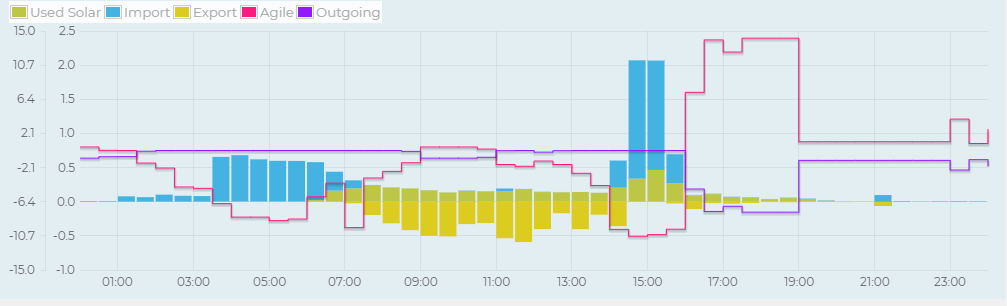
The figures below show screenshots of two types of electrical energy data monitoring. Fig.4. shows the electricity consumption pattern for one day using Octopus agile ToU tariff. The pink line shows the 30-minute wholesale electricity price, blue bars are grid consumption, yellow bars are solar generation exported, and green bars are solar generation consumed on-site. In this view, the house battery was charged at night and the EV was charged in the afternoon, both to absorb surplus grid power when the electricity price was negative, i.e. getting paid to charge batteries.

Fig.4. Energy Monitoring ‘Octopus Agile’ App view on 23/05/2020.

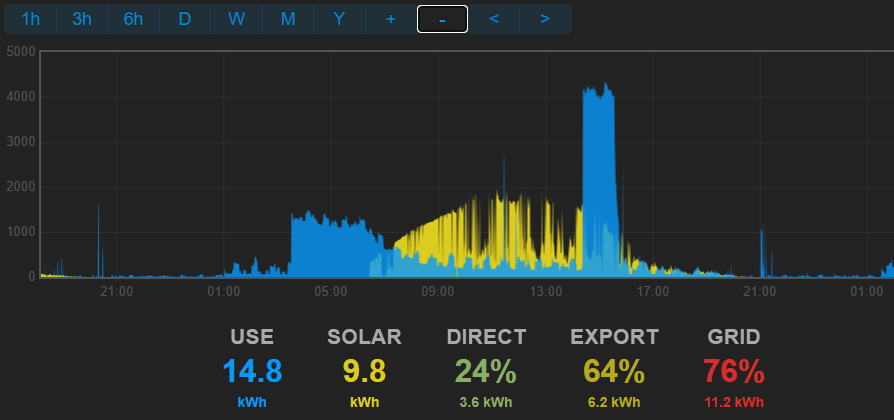
The solar generation (Yellow) and electrical consumption (Blue) are shown for the same day using the ‘MY Solar’ App in Fig.5. (note the slightly longer timescale on this view). The full screen view shows real-time values for solar generation, export, and consumption (not shown here). What this day shows is that grid import was high as there was monetary incentive to do so, and solar export was also high as the battery was charged overnight.

Fig.5. Energy Monitoring ‘My Solar’ App view on 23/05/2020.

Space Heating

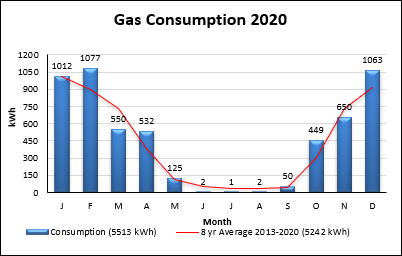
Total annual household gas consumption decreased by 8% on the previous year to 5513 kWh, derived from monthly meter readings, shown as a column chart in Fig.6. All consumption was provided by the gas grid, and given a carbon intensity figure of 0.204 kgCO2e/kWh (DECC, 2020). This resulted in a decrease of 101kgCO2e to 1125 kgCO2e or 1.1 tCO2e emissions. The decrease was due to water heating now being supplied by electricity.

Fig.6. Monthly gas consumption data.

Car Travel

The car in use was a BMWi3 battery electric vehicle (BEV). The annual mileage estimated to the nearest 1000 reduced considerably to 9000 miles, or 15000 km, a consequence of the Covid-19 pandemic travel limitations. As the fuel is electricity, the carbon intensity figure of fuel production and use in an electric vehicle is the same as is given for grid electricity, which this year was 0.253 kgCO2e/kWh (DECC, 2020) for a 2020 generation mix. The car consumed 2014 kWh of electricity to charge, derived from monthly readings of the night time consumption meter and shown as a column chart in Fig.7., which highlights the travel reduction particularly during March-May, resulting in a reduction in fuel production emissions only to 510 kgCO2e or 0.5 tCO2e.

Note: In the units previously given for vehicle emissions, 2020 grid electricity equates to 0.034 kgCO2e/km.

Fig.7. Monthly car charging data.

Water Consumption

Total annual household water consumption was reduced to 11 m3, derived from a utility bill for that year. The 2020 carbon intensity figure of domestic water supply (0.344 kgCO2e/m3), and treatment (0.708 kgCO2e/m3) is given as 1.052 kgCO2e/m3 (DECC, 2020). This resulted in a 40% reduction of 8 kgCO2e to 12 kgCO2e or 0.01 tCO2e emissions.

Lifestyle

In July, an investment was made in Ripple Energy Graig Fatha Wind Turbine project, the UK’s first consumer-owned renewable energy generation source, primarily to get renewable sources built, but with the addition of providing a zero-carbon source of electricity to power the electric car during winter when solar power is minimal, and revenue which will eliminate the electricity bill. This did not affect the results for lifestyle in the carbon footprint calculator (WWF, 2020), so emissions remained at 0.5 tCO2.

Infrastructure

The figure for infrastructure emissions in the carbon footprint calculator (WWF, 2020) remained at 2.75 tCO2 for each UK citizen. The annual donation to the Woodland Trust to plant 25 m2 of woodland, and the 14 trees planted off-set and sequester -1.14 tCO2 of these indirect emissions.

Behaviours

There was a forced behavioural change in this year for health reasons. The bathroom had to be re-modelled to a wet-room for wheelchair access. This meant removal of the bath, and installation of an electric thermostatic shower. The energy implication of this resulted in reducing gas consumption by using battery, solar and grid electricity to heat water for showering, and water consumption was reduced by only taking showers.

Conclusions

Overall, emissions decreased compared to the previous year by 9% or 0.4 tCO2e, resulting in 63% or 6.7 tCO2e lower compared to the baseline year. The decrease was due mostly to reduced travel from the Covid-19 pandemic lock-down travel limitations. There was a further slight decrease in gas consumption for space heating. The reduction would have been greater but was limited by below average solar generation. There was also a significant reduction in water use, due to the removal of the bath.

References

The Department for Energy and Climate Change (2020). Greenhouse gas reporting – Conversion factors 2020. Available at: Greenhouse gas reporting: conversion factors 2020 – GOV.UK (www.gov.uk) (accessed 14th December 2023).

WWF-UK (2020). Available at: WWF Footprint Calculator (accessed January 2021).

The Road to Carbon-Zero 2019 – A Low-Carbon Grid & Time-of-Use Tariffs

Overview

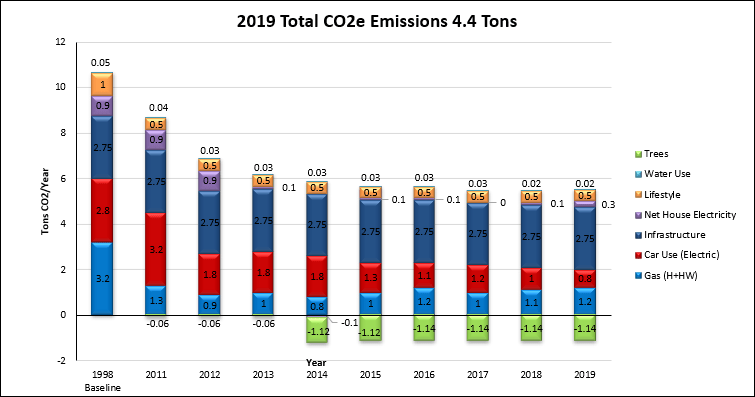
The first full year with battery storage, and the low-carbon intensity of the grid begins to make electrifying everything viable, combining EV’s, battery storage, and time-of-use (ToU) tariffs. Innovative energy company Octopus introduce several of these ToU tariffs, and switching onto their Agile tariff, which follows the wholesale price of electricity every half hour using the smart meter, enabled being paid to store electricity in the EV and house battery when there is surplus supply on the grid system, usually at night and from wind power sources. In addition, during the evening peak the battery can then be discharged to prevent paying the highest cost to import power. The carbon fingerprint is shown in Fig.1. in comparison with previous years and baseline.

Fig.1. The fingerprint of CO2e emissions in 2019, in comparison with previous years and baseline.

Solar Power Generation

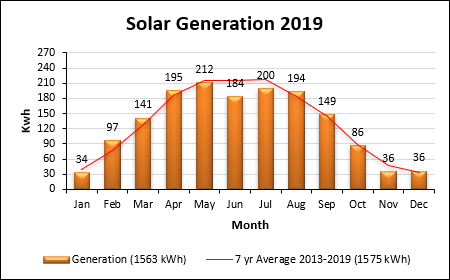
The total solar power generation for the year decreased on the previous year by 49 kWh, back close to the seven-year annual average, to 1563 kWh, derived from reading the generation meter. The monthly solar generation data are shown in Fig.2.

Fig.2. Monthly solar generation data.

Household Electricity Consumption

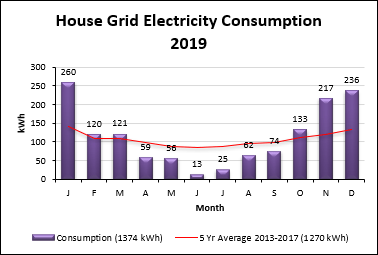
Total annual household electricity grid consumption increased on the previous year by 346 kWh or 34% to 1374 kWh, again derived from reading the electricity meter. The monthly grid electricity consumption data are shown in Fig.3. The chart shows clearly during this full year with the EES system, that during the summer months grid consumption for the home is greatly reduced by the combination of solar generation and battery discharge. Conversely, during the winter months, grid consumption increases due to battery charging and reduced solar generation. However, as outlined in 2018, most of this consumption is drawn at night giving benefit to grid balancing, and benefits the consumer through lower cost time-of-use (ToU) tariffs. In carbon terms, nighttime charging is also desirable as the carbon intensity is lower, however this is not reflected in the footprint as an annual average carbon intensity figure is used.

Fig.3. Monthly grid electricity consumption data.

The assumption was made that only 25% of solar generation was exported, and 75% was consumed on-site. Therefore, 1374 kWh grid consumption minus 391 kWh solar export resulted in a net grid electricity consumption of 983 kWh. Grid electricity was given a carbon intensity figure of 0.278 kgCO2e/kWh (DECC, 2019) for a 2019 generation mix. The combined solar self-consumption and exported generation resulted in an emission increase of 200 kgCO2e to 270 kgCO2e or 0.27 tCO2e.

Space and Water Heating

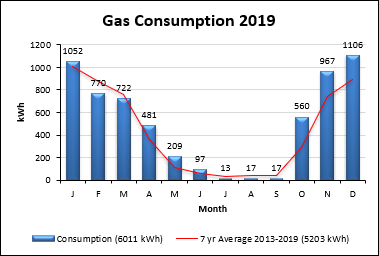
Total annual household gas consumption increased by 7% on the previous year to 6011 kWh, derived from monthly meter readings, shown as a column chart in Fig.4. All consumption was provided by the gas grid, and given a carbon intensity figure of 0.204 kgCO2e/kWh (DECC, 2019). This resulted in an increase of 83kgCO2e to 1226 kgCO2e or 1.2 tCO2e emissions.

Fig.4. Monthly gas consumption data.

Car Travel

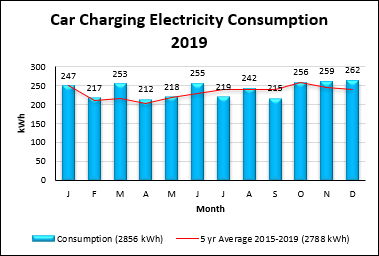
The car in use was a battery electric vehicle (BEV). The annual mileage estimated to the nearest 1000 reduced to 13000 miles, or 21000 km. As the fuel is electricity, the carbon intensity figure of fuel production and use in an electric vehicle is the same as is given for grid electricity, which this year was 0.278 kgCO2e/kWh (DECC, 2019) for a 2019 generation mix. The car consumed 2856 kWh of electricity to charge, derived from monthly readings of the night time consumption meter and shown as a column chart in Fig.5., resulting in a reduction in fuel production emissions only to 798 kgCO2e or 0.8 tCO2e.

Note: In the units previously given for vehicle emissions, 2019 grid electricity equates to 0.038 kgCO2e/km.

Fig.5. Monthly car charging data.

Water Consumption

Total annual household water consumption remained at 19 m3, derived from a utility bill for that year. The 2019 carbon intensity figure of domestic water supply (0.344 kgCO2e/m3), and treatment (0.708 kgCO2e/m3) is given as 1.052 kgCO2e/m3 (DECC, 2019). This resulted in no change at 0.02 tCO2e emissions.

Lifestyle

There were no additional lifestyle changes this year, and those already made continued which did not affect the results for lifestyle in the carbon footprint calculator (WWF, 2019), so emissions remained at 0.5 tCO2.

Infrastructure

The figure for infrastructure emissions in the carbon footprint calculator (WWF, 2019) remained at 2.75 tCO2 for each UK citizen. The annual donation to the Woodland Trust to plant 25 m2 of woodland, and the 14 trees planted off-set and sequester -1.14 tCO2 of these indirect emissions.

Behaviours

All previous behaviours continued, with the only addition being the management of the EES battery system along with a ToU tariff to maximise charging and discharging regimes to reduce peak-time grid consumption, cost, and emissions, and maximise electricity storage from solar and off-peak surplus grid power.

Conclusions

Overall, emissions increased slightly compared to the previous year by 2% or 0.1 tCO2e, resulting in 59% or 6.3 tCO2e lower compared to the baseline year. The increase was due to a slight increase in gas consumption for space heating. A further increase could have resulted from lower solar generation and increased winter electricity consumption to charge the EES battery, however this was avoided due to a further reduction in the carbon intensity of grid electricity as more renewable generators were again added to the mix, and a reduction in mileage reduced the emissions from car travel. Water use remained stable at a low level.

Octopus Energy Referral code worth £50,  https://share.octopus.energy/oak-moose-437

References

The Department for Energy and Climate Change (2019). Greenhouse gas reporting – Conversion factors 2019. Available at: Greenhouse gas reporting: conversion factors 2019 – GOV.UK (www.gov.uk) (accessed 14th December 2023).

WWF-UK (2019). Available at: WWF Footprint Calculator (accessed January 2020).

The Road to Carbon-Zero 2018 – The Electrical Energy Storage (EES) House Battery

Overview

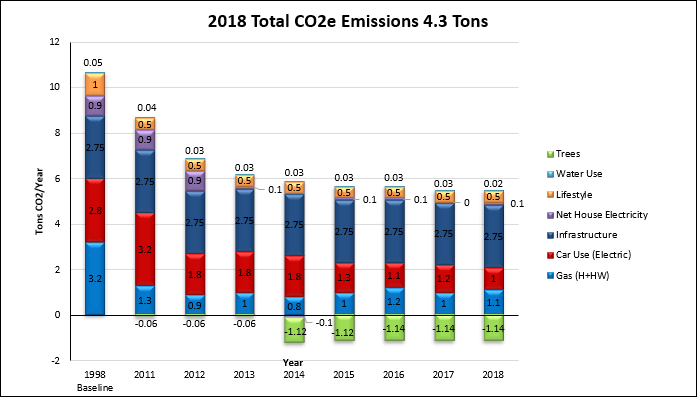
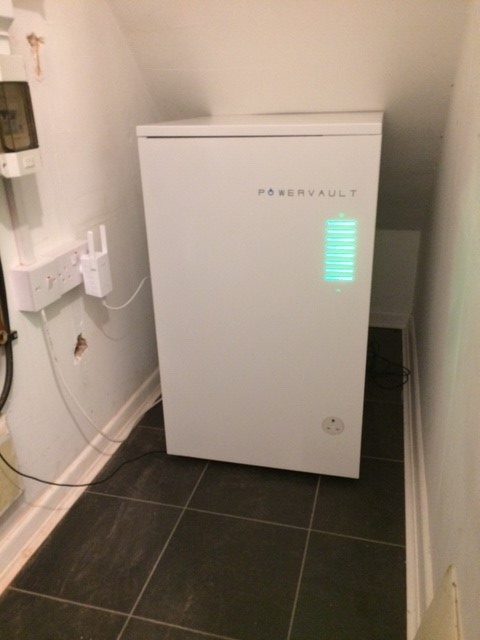
In June 2018, the 4 kWh Powervault EES system was commissioned, with the purpose of storing and using more of the solar power generated on-site. The grid-connected EES and energy management system consists of six 110 Ah (Amp-hour) 12 V (Volt) or 1.3 kWh lead-acid gel, tubular plate, deep-cycle, deep discharge batteries, the type typically used for caravans, motorhomes, and similar applications. The 7.8-kWh capacity facilitates 4 kWh of usable power, ensuring the batteries are rarely discharged below 50%, and never close to the maximum depth of discharge of 80%. The typical maximum cycle-life of these batteries is 1500 cycles, equivalent to four years of one charge/discharge cycle per day. However, preventing the depth of discharge exceeding 50% regularly through a higher storage capacity than that needed, intends to extend this usable life to five or six years. The carbon fingerprint is shown in Fig.1. in comparison with previous years and baseline.

Fig.1. The fingerprint of CO2e emissions in 2018, in comparison with previous years and baseline.

Solar Power Generation

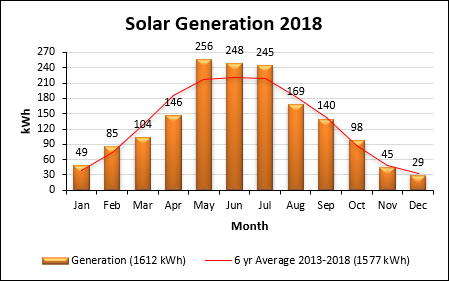
The total solar power generation for the year increased considerably on the previous year by 116 kWh to 1612 kWh, well above the six-year average, derived from reading the generation meter. The monthly solar generation data are shown in Fig.2., highlighting the increased solar irradiance in May, June, and July this year.

Fig.2. Monthly solar generation data.

Household Electricity Consumption

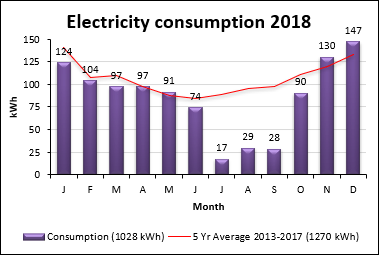
Total annual household electricity grid consumption was reduced on the previous year by 161 kWh or 14% to 1028 kWh, again derived from reading the electricity meter. This was due to the increased solar generation, and the connection of the Electrical Energy Storage Battery at the end of June, shown in Fig.3.

Fig.3. The 4 kWh EES system, similar in size to a dishwasher, located under the stairs.

The monthly grid electricity consumption data are shown in Fig.4. Using the five-year average trendline shows the dramatic reduction of grid electricity consumed during the summer, due to the discharge of stored solar power from the battery, and an increase in grid consumption during the winter, due to charging the battery overnight. However, this higher overnight consumption is good for grid balancing as there is often a surplus of power at night from low-carbon sources like wind, and is also at a cheaper rate for the consumer to purchase than the daytime rate.

Fig.4. Monthly grid electricity consumption data.

The assumption of 25% solar self-consumption had to be revised this year. Monitoring of the solar/grid/battery system in later years determined that with the battery connected only 25% of solar generation was exported, and 75% was consumed on-site. However, the battery was installed half way through this year, so the assumption was made that solar self-consumption was 50%. Therefore, 1028 kWh grid consumption minus 806 kWh solar export resulted in a net grid electricity consumption of 222 kWh. Grid electricity was given a carbon intensity figure of 0.307 kgCO2e/kWh (DECC, 2018) for a 2018 generation mix. The combined solar self-consumption and exported generation resulted in an emission increase of 42 kgCO2e to 68 kgCO2e or 0.07 tCO2e.

Note: The data does not display the benefits of the battery to the grid system of increased consumption using less carbon intense off-peak overnight power to reduce peak-time high carbon power use from the grid (load shifting), and reducing wind power curtailment.

Space and Water Heating

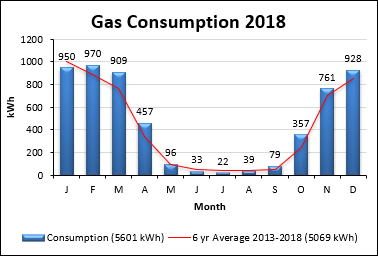
Total annual household gas consumption increased by 16% on the previous year to 5601 kWh, derived from monthly meter readings, shown as a column chart in Fig.5. The chart shows the increase was likely due to cooler than average Spring and Autumn seasons. All consumption was provided by the gas grid, and given a carbon intensity figure of 0.204 kgCO2e/kWh (DECC, 2018). This resulted in an increase of 153kgCO2e to 1143 kgCO2e or 1.1 tCO2e emissions.

Fig.5. Monthly gas consumption data.

Car Travel

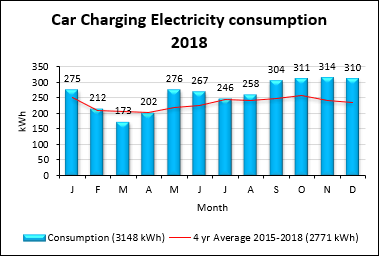
The car in use was a battery electric vehicle (BEV). The annual mileage estimated to the nearest 1000 remained at 14000 miles, or 22000 km. As the fuel is electricity, the carbon intensity figure of fuel production and use in an electric vehicle is the same as is given for grid electricity, which this year was 0.307 kgCO2e/kWh (DECC, 2018) for a 2018 generation mix. The car consumed 3148 kWh of electricity to charge, well above the four-year average, derived from monthly readings of the night time consumption meter and shown as a column chart in Fig.6., but resulted in a reduction in fuel production emissions only to 968 kgCO2e or 1.0 tCO2e, due to the lower carbon intensity of grid electricity. 

Note: In the units previously given for vehicle emissions, 2018 grid electricity equates to 0.044 kgCO2e/km.

Fig.6. Monthly car charging data.

Water Consumption

Total annual household water consumption was reduced to 19 m3, derived from a utility bill for that year. The 2018 carbon intensity figure of domestic water supply (0.344 kgCO2e/m3), and treatment (0.708 kgCO2e/m3) is given as 1.052 kgCO2e/m3 (DECC, 2018). This resulted in a reduction of 12 kgCO2e to 20 kgCO2e or 0.02 tCO2e emissions.

Lifestyle

There were no additional lifestyle changes this year, and those already made continued which did not affect the results for lifestyle in the carbon footprint calculator (WWF, 2018), so emissions remained at 0.5 tCO2.

Infrastructure

The figure for infrastructure emissions in the carbon footprint calculator (WWF, 2018) remained at 2.75 tCO2 for each UK citizen. The annual donation to the Woodland Trust to plant 25 m2 of woodland, and the 14 trees planted off-set and sequester -1.14 tCO2 of these indirect emissions.

Behaviours

All previous behaviours continued, with the only addition being the management of the EES battery system to maximise charging and discharging regimes to reduce peak-time grid consumption, cost, and emissions, and maximise electricity storage from solar and off-peak surplus grid power.

Conclusions

Overall, emissions remained the same compared to the previous year, and 59% or 6.4 tCO2e lower compared to the baseline year. The increases in gas and grid electricity emissions (due to increased solar self-consumption resulting in less export to the grid) were negated by a large reduction in the emission factor for grid electricity as more renewable generators were again added to the mix, which greatly reduced the emissions from car travel in particular. A further contribution came from a reduction in water use.

References

The Department for Energy and Climate Change (2018). Greenhouse gas reporting – Conversion factors 2018. Available at: Greenhouse gas reporting: conversion factors 2018 – GOV.UK (www.gov.uk) (accessed 20 January 2019).

WWF-UK (2018). Available at: WWF Footprint Calculator (accessed 20 January 2019).