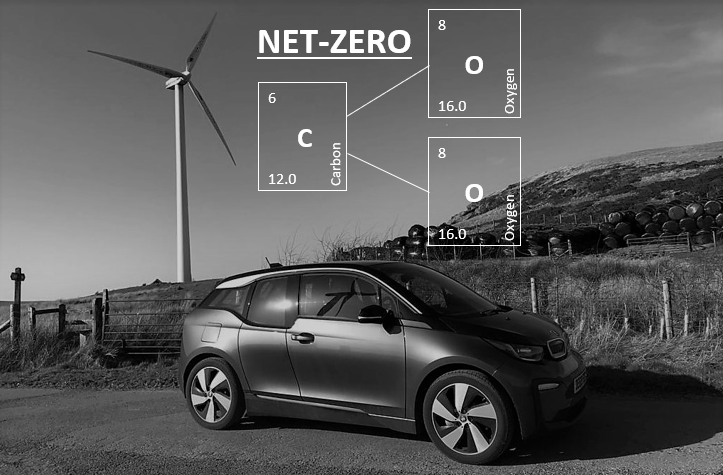
The Road to Carbon-Zero 2023  – Electrification of Everything

Introduction

In October this year, an Air-source heat pump was installed, electrifying the space and water heating of the dwelling, and completing the electrification of everything. On November 3rd the gas meter was removed and the supply disconnected. From this moment, the dwelling and travel were 100% fossil-fuel free; net-zero carbon emissions; and net-zero energy bills. In terms of personally controllable emissions, by omitting infrastructure emissions, the value was carbon negative by 0.25 tCO2e. A landmark moment for an average UK dwelling, car mileage, and modern lifestyle. The carbon fingerprint is shown in Fig.1. in comparison with previous years and baseline.

Fig.1. The fingerprint of CO2e emissions in 2023, in comparison with previous years and baseline.

Solar Power Generation

The total solar power generation for the year increased by 422 kWh to 2383 kWh, mainly due to the first full year’s generation from the secondary array, derived from reading the generation meters. The primary array data shows that solar irradiance was lower this year than the 10-year average. The monthly solar generation data are shown in Fig.2.
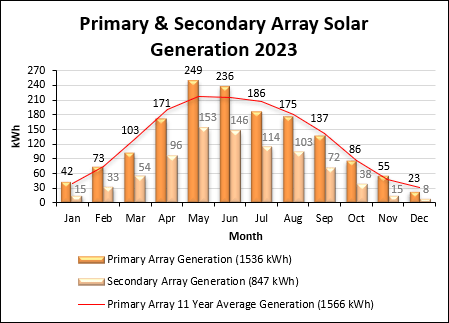
Fig.2. Monthly solar generation data.

Wind Power Generation

The total wind power generation from my ownership share in the Graig Fatha turbine for this first full year was 4926 kWh, displacing this amount of conventional grid electricity generation with carbon intensity of 0.225 kgCO2e/kWh (DECC, 2023) for a 2023 generation mix. This resulted in an emission off-set of 1108 kgCO2e or 1.1 tCO2e. The monthly wind generation data were derived from my personal Ripple dashboard, and are shown in Fig.3.

Consumer-owned Energy Provider Ripple Energy Referral code worth £25: https://rippleenergy.com?ogu=319&rtrfn=Paul-M
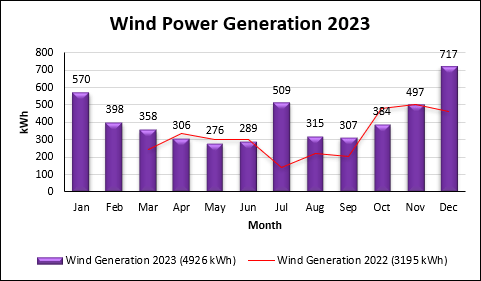
Fig.3. Monthly wind power generation data.

Household Electricity Consumption

Total annual household electricity grid consumption was reduced on the previous year by 23 kWh or 2% to 1177 kWh, again derived from reading the electricity meter. Consumption this year was well below the five-year average, again mainly due to the secondary solar array. The monthly grid electricity consumption data are shown in Fig.4.
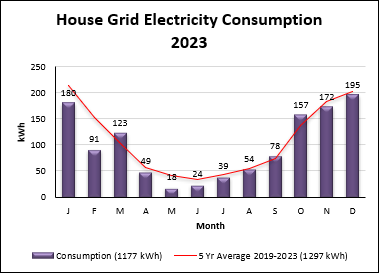
Fig.4. Monthly grid electricity consumption data.

The assumption was made that only 25% of solar generation was exported, and 75% was consumed on-site. Therefore, 1177 kWh grid consumption minus 596 kWh solar export resulted in a net grid electricity consumption of 581 kWh. Grid electricity was given a carbon intensity figure of 0.225 kgCO2e/kWh (DECC, 2023) for a 2023 generation mix. The combined solar self-consumption and exported generation resulted in an emission decrease of 19 kgCO2e to 131 kgCO2e or 0.1 tCO2e.

Green Energy Supplier Octopus Energy Referral code worth £50: https://share.octopus.energy/oak-moose-437

Space and Water Heating

Space heating and minimal water heating was provided by the gas grid between January and October. Total annual household gas consumption decreased by 29% on the previous year to 3479 kWh, derived from monthly meter readings, shown as a column chart in Fig.5., and given a carbon intensity figure of 0.2 kgCO2e/kWh (DECC, 2023). This resulted in a decrease of 289kgCO2e to 696 kgCO2e or 0.7 tCO2e emissions.

In the last week of October, the Mitsubishi Ecodan 5 kW Air-source heat pump (ASHP), pictured in Fig.6., was commissioned and began providing all space and water heating electrically for the remainder of the year. The ASHP is assumed to consume all the solar generation which is not exported through the winter months, but is supplied mostly by the electricity grid directly, and indirectly by the battery during peak hours. The ASHP consumed 664 kWh of grid electricity, derived from both a meter and the heating controller, and was given a carbon intensity figure of 0.225 kgCO2e/kWh (DECC, 2023) for a 2023 generation mix. This resulted in 149 kgCO2e or 0.1 tCO2e emissions. The consumption is shown in comparison with gas in Fig.5.
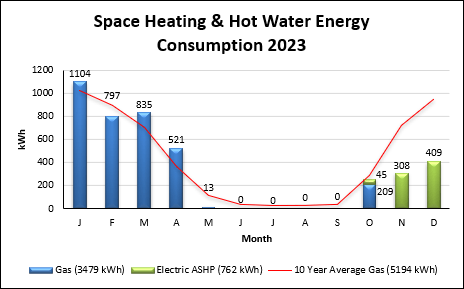
Fig.5. Monthly Space & water heating energy consumption data.

The chart shows how much more efficient the ASHP is, using considerably less energy to provide more heat to the space and water. The house was considerably warmer and more comfortable constantly after the installation. The combination of solar generation, battery storage, and cheap over-night electricity tariff meant the cost was less than gas heating, and these costs were offset by the revenue from the wind turbine and solar Feed-in-Tariff. Net-zero carbon, net-zero cost heating!

Fig.6. The Mitsubishi Ecodan 5 kW Air-source heat pump, located on the side of the property.

Car Travel

The car in use was a battery electric vehicle (BEV). At the end of 2022, the BMW i3 was changed for a Hyundai Kona, pictured in Fig.8. This car is similar in size to the original 100-mile range 24 kWh battery Nissan Leaf, but has a 64 kWh battery providing up to 350 miles of range on a full charge, demonstrating the improvements in battery chemistry and energy density since 2014. The annual mileage estimated to the nearest 1000 remained at 12000 miles, or 19000 km. However, this year the car was able to be charged directly from the solar arrays, and 224 kWh was delivered this way equating to approximately 1500 km. This meant grid consumption was reduced, providing 17,500 km of travel. As the fuel is electricity, the carbon intensity figure of fuel production and use in an electric vehicle is the same as is given for grid electricity, which this year was 0.225 kgCO2e/kWh (DECC, 2023) for a 2023 generation mix. The car consumed 2309 kWh of electricity to charge, derived from monthly readings of the night time consumption meter and shown as a column chart in Fig.6., resulting in fuel production emissions only remaining at 520 kgCO2e or 0.5 tCO2e.

Note: In the units previously given for vehicle emissions, 2023 grid electricity equates to 0.030 kgCO2e/km.
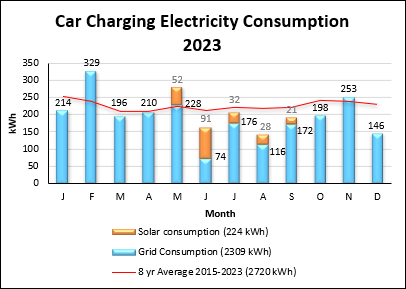
Fig.7. Monthly car charging data. (Note: 8-year average excludes 2020 due to pandemic lock-down anomaly).
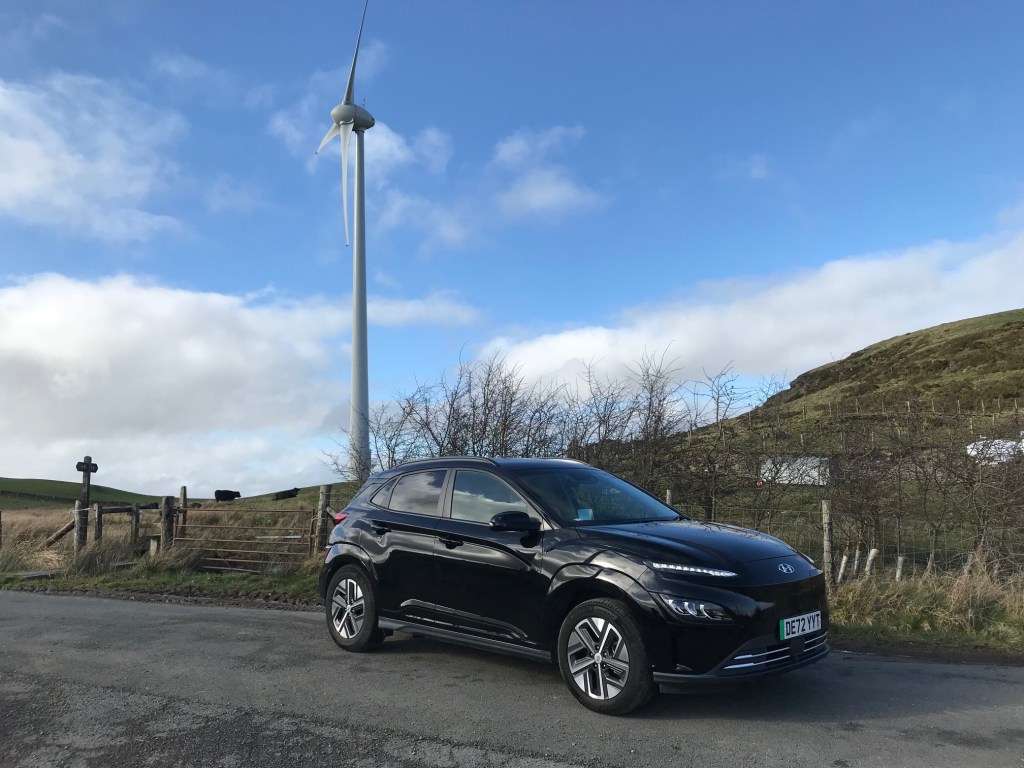
Fig.8. The 64 kWh Battery Electric Hyundai Kona.  

Water Consumption

Total annual household water consumption was reduced to 10 m3, derived from a utility bill for that year. The 2022 carbon intensity figure of domestic water supply (0.149 kgCO2e/m3), and treatment (0.272 kgCO2e/m3) is given as 0.421 kgCO2e/m3 (DECC, 2023). This resulted in a 20% reduction of 1 kgCO2e to 4 kgCO2e or 0.0 tCO2e emissions.

Lifestyle

There were no changes regarding lifestyle in this year, so there was no effect to the results for lifestyle in the carbon footprint calculator (WWF, 2023), and emissions remained at 0.5 tCO2.

Infrastructure

The figure for infrastructure emissions in the carbon footprint calculator (WWF, 2023) remained at 2.75 tCO2 for each UK citizen. The annual donation to the Woodland Trust to plant 25 m2 of woodland, the 14 trees planted, and the green roof and wall off-set and sequester -1.15 tCO2 of these indirect emissions.

Behaviours

The addition of the Air-source heat pump required some adjustment to the use of the electrical energy storage (EES) battery. During the winter months, the battery was now charged every night at off-peak rate to discharge and power the heat pump during peak-time periods during the day and evening. It should also be noted that the lead-acid battery after five years of use had, expectedly, reduced in storage capacity by 0.5 kWh. Increased electricity consumption from the heat pump, and reducing battery storage capacity would require a battery upgrade in the next year.

Conclusions

Overall, emissions decreased compared to the previous year by 19% or 0.6 tCO2e, resulting in 77% or 8.2 tCO2e lower emissions compared to the baseline year. A reduction in gas consumption through replacement in the last quarter of the year with the ASHP accounted for 0.3 tCO2e of the decrease. For the second successive year, wind power generation completely off-set all electricity grid consumption for both the home and travel, and this year that included the power consumption of the heat pump for space and water heating, also providing an excess and the remaining 0.3tCO2e reduction through displacing emissions from the National Grid.

References

The Department for Energy and Climate Change (2023). Greenhouse gas reporting – Conversion factors 2023. Available at: Greenhouse gas reporting: conversion factors 2022 – GOV.UK (www.gov.uk) (accessed 17th December 2023).

WWF-UK (2023). Available at: WWF Footprint Calculator (accessed January 2023).
The Road to Carbon-Zero 2021 – Adapting to Climate Change & Enhancing Biodiversity

Overview

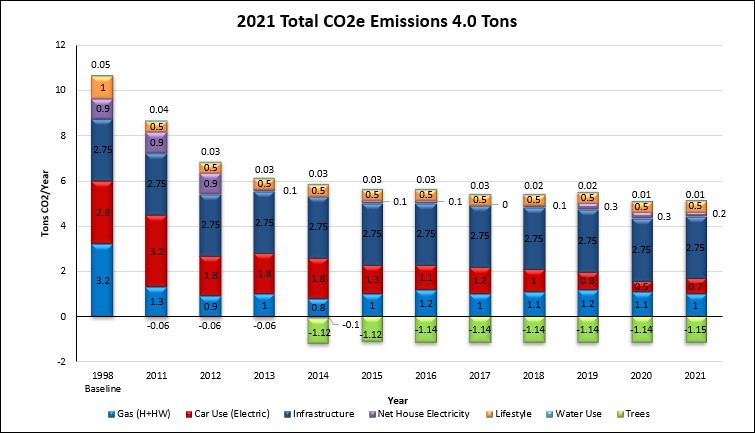
In this year, measures were taken to adapt to the already noticeable and future impacts of Climate Change. A green wall and green roof were planted to reduce heat absorption of the building and cool the air around the building, whilst also absorbing atmospheric carbon and rainfall and enhancing biodiversity. On the South-East facing windows, plantation shutters were installed, to reduce heat gain in summer and heat loss in winter of the building interior. The carbon fingerprint is shown in Fig.1. in comparison with previous years and baseline.

Fig.1. The fingerprint of CO2e emissions in 2021, in comparison with previous years and baseline.

Solar Power Generation

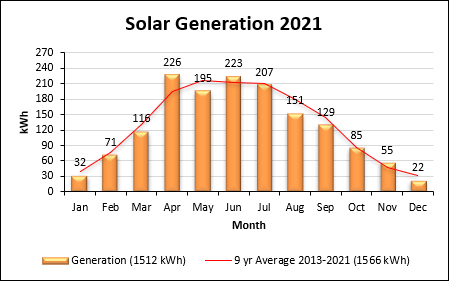
The total solar power generation for the year decreased slightly by 47 kWh to 1512 kWh, derived from reading the generation meter. The monthly solar generation data are shown in Fig.2. Annual generation was lower than the nine-year average, but monthly generation showed a typical pattern apart from a high reading for April.

Fig.2. Monthly solar generation data.

Household Electricity Consumption

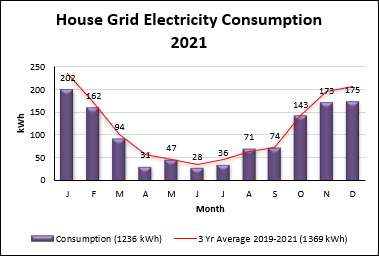
Total annual household electricity grid consumption was reduced on the previous year by 260 kWh or 17% to 1236 kWh, again derived from reading the electricity meter. The monthly grid electricity consumption data are shown in Fig.3.

Fig.3. Monthly grid electricity consumption data.

The assumption was made that only 25% of solar generation was exported, and 75% was consumed on-site. Therefore, 1236 kWh grid consumption minus 378 kWh solar export resulted in a net grid electricity consumption of 858 kWh. Grid electricity was given a carbon intensity figure of 0.231 kgCO2e/kWh (DECC, 2021) for a 2021 generation mix. The combined solar self-consumption and exported generation resulted in an emission decrease of 81 kgCO2e to 198 kgCO2e or 0.2 tCO2e.

In July, the Octopus Agile electricity tariff was changed to another ToU tariff Octopus Go, an EV tariff which gives four hours of super cheap electricity to charge the EV and house battery at night, bringing further cost reduction.

Space and Water Heating

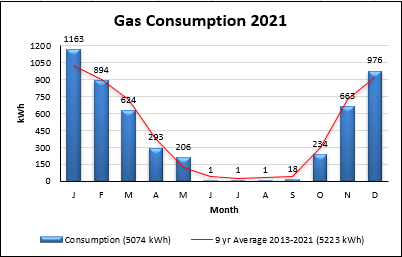
Total annual household gas consumption decreased by 8% on the previous year to 5074 kWh, derived from monthly meter readings, shown as a column chart in Fig.4. All consumption was provided by the gas grid, and given a carbon intensity figure of 0.203 kgCO2e/kWh (DECC, 2021). This resulted in a decrease of 95kgCO2e to 1030 kgCO2e or 1.0 tCO2e emissions.

Fig.4. Monthly gas consumption data.

Car Travel

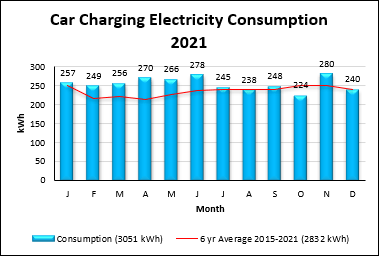
The car in use was a battery electric vehicle (BEV). The annual mileage estimated to the nearest 1000 increased considerably on the previous year back to 14000 miles, or 22000 km. As the fuel is electricity, the carbon intensity figure of fuel production and use in an electric vehicle is the same as is given for grid electricity, which this year was 0.231 kgCO2e/kWh (DECC, 2021) for a 2021 generation mix. The car consumed 3051 kWh of electricity to charge, derived from monthly readings of the night time consumption meter and shown as a column chart in Fig.5., resulting in an increase in fuel production emissions only to 705 kgCO2e or 0.7 tCO2e.

Note: In the units previously given for vehicle emissions, 2021 grid electricity equates to 0.032 kgCO2e/km.

Fig.5. Monthly car charging data. (Note: 6-year average excludes 2020 due to pandemic lock-down anomaly).

Water Consumption

Total annual household water consumption remained at 11 m3, derived from a utility bill for that year. However, the 2021 carbon intensity figure of domestic water supply (0.149 kgCO2e/m3), and treatment (0.272 kgCO2e/m3) given as 0.421 kgCO2e/m3 (DECC, 2021), was reduced by 60% on the previous year. This resulted in an equivalent reduction in emissions of 7 kgCO2e to 5 kgCO2e, but rounding meant emissions remained at 0.01 tCO2e in the footprint.

Adapting to Climate Change & Enhancing Biodiversity

A green wall was planted to cover the walls of the stand-alone garage (Fig.6.). This consisted of native ivy shrubs which, when fully grown, will cover 8m2 of concrete wall. Some low growing shrubs were also planted consisting of box and heat tolerant Mediterranean herbs. This should prevent the South-facing concrete walls of the garage absorbing and storing heat, cooling the space, and will provide a new feeding resource and habitat for many invertebrates and birds.

Fig.6. The freshly planted green wall.

A small wildlife pond (Fig.7.) was also created to provide new habitat for aquatic species, particularly frogs and newts. This also reflects sunlight and further cools the space through evaporation in summer, and provides an additional water store throughout the year.

Fig.7. The wildlife pond with flag iris in flower.

To cover an 18m2 area flat-roof extension at the rear of the property, a light-weight extensive sedum green-roof system was installed (Fig.8.). Green roofs provide multiple benefits, such as protecting the external roof layer from UV light and weather damage, prolonging the life of the roof; reducing rain-water run-off rate during heavy rainfall; cooling the air, reducing the urban heat island effect; insulating the roof, reducing internal heat loss in winter and heat gain in summer; enhancing biodiversity through providing an important food resource for pollinators such as native bumble and solitary bees and butterflies during the summer months; and absorbing carbon dioxide from the atmosphere. They are also aesthetically very pleasing, particularly in summer.

Fig.8. The light-weight extensive sedum green-roof system in full bloom in summer.

Plantation shutters (Fig.9.), in a highly reflective white, were fitted on the front SE facing windows. These were intended to have the double benefit of keeping in heat in winter and heat out in summer. They can also be opened right out to allow passive thermal solar gain during the heating season. Primarily these will have most benefit in winter and some benefit in summer, but with future predictions of higher summer temperatures, the summer benefit should increase.

Fig.9. The plantation shutters, in a highly reflective white, on the front SE facing windows.

Lifestyle & Behaviours

There were no changes regarding lifestyle and behaviours in this year, so there was no effect to the results for lifestyle in the carbon footprint calculator (WWF, 2021), and emissions remained at 0.5 tCO2.

Infrastructure

The figure for infrastructure emissions in the carbon footprint calculator (WWF, 2021) remained at 2.75 tCO2 for each UK citizen. The annual donation to the Woodland Trust to plant 25 m2 of woodland, and the 14 trees planted to off-set and sequester these indirect emissions were joined by a small contribution from the green roof and wall, estimated to be 10 kg per year, resulting in a total value of -1.15 tCO2/year.

Conclusions

Overall, emissions remained stable compared to the previous year, and 63% or 6.7 tCO2e lower compared to the baseline year. Small decreases in emissions for gas consumption and net household electricity use, and further sequestration from added vegetation, were cancelled out by an increase in emissions for car travel as normal mileage resumed compared to the pandemic lock-down restrictions of the previous year. In addition, below average solar generation was countered by a reduction in electricity use.

References

The Department for Energy and Climate Change (2021). Greenhouse gas reporting – Conversion factors 2021. Available at: Greenhouse gas reporting: conversion factors 2021 – GOV.UK (www.gov.uk) (accessed 16th December 2023).
WWF-UK (2021). Available at: WWF Footprint Calculator (accessed January 2022).

The Road to Carbon-Zero 2017 – Five Years of Primary Empirical Data

Overview

Again, there were no significant carbon reducing measures taken in 2017, although some small reductions were still achieved. However, the recorded data did provide an opportunity to see how this year’s electricity and gas consumption, and solar generation compared to the five-year average from 2013-2017, and a three-year average from 2015-2017 for car charging electricity consumption. The carbon fingerprint is shown in Fig.1. in comparison with previous years and baseline.

Fig.1. The fingerprint of CO2e emissions in 2017, in comparison with previous years and baseline.

Solar Power Generation

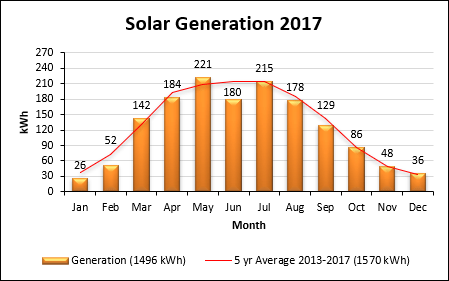
The total solar power generation for the year decreased slightly by 45 kWh to 1496 kWh, derived from reading the generation meter, and was well below the five-year average of 1570 kWh. The monthly solar generation data are shown in Fig.2.

Fig.2. Monthly solar generation data.

Household Electricity Consumption

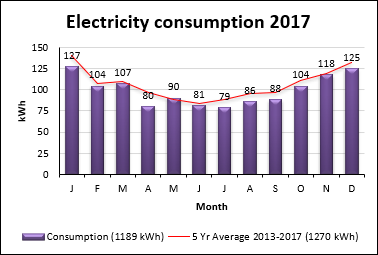
Total annual household electricity grid consumption was reduced on the previous year by 111 kWh or 9% to 1189 kWh, again derived from reading the electricity meter. This was also below the five-year average. The monthly grid electricity consumption data are shown in Fig.3.

Fig.3. Monthly grid electricity consumption data.

Using the assumption of 25% solar self-consumption, this year, 1189 kWh grid consumption minus 1122 kWh solar export resulted in a net grid electricity consumption of 67 kWh. Grid electricity was given a carbon intensity figure of 0.385 kgCO2e/kWh (DECC, 2017) for a 2017 generation mix. The combined solar self-consumption and exported generation resulted in an emissions reduction of 39 kgCO2e to 26 kgCO2e or 0.03 tCO2e.

Space and Water Heating

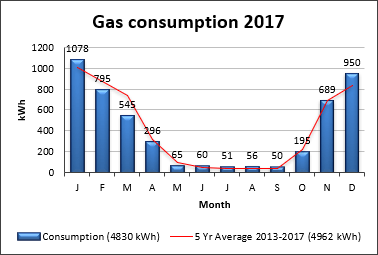
Total annual household gas consumption decreased by 18% on the previous year to 4830 kWh, derived from monthly meter readings, shown as a column chart in Fig.4. The chart reveals a warmer Spring season compared to the average and much warmer than the previous year, resulting in the lower-than-average gas consumption. All consumption was provided by the gas grid, and given a carbon intensity figure of 0.205 kgCO2e/kWh (DECC, 2017). This resulted in a decrease of 216kgCO2e to 990 kgCO2e or 1.0 tCO2e emissions.

Fig.4. Monthly gas consumption data.

Car Travel

The car in use was a battery electric vehicle (BEV). The annual mileage estimated to the nearest 1000 increased to 14000 miles, or 22000 km. As the fuel is electricity, the carbon intensity figure of fuel production and use in an electric vehicle is the same as is given for grid electricity, which this year was 0.385 kgCO2e/kWh (DECC, 2017) for a 2017 generation mix. The car consumed 3033 kWh of electricity to charge, well above the three-year average, derived from monthly readings of the night time consumption meter and shown as a column chart in Fig.5., resulting in an increase in fuel production emissions only to 1168 kgCO2e or 1.2 tCO2e.

Note: In the units previously given for vehicle emissions, 2017 grid electricity equates to 0.053 kgCO2e/km.

Fig.5. Monthly car charging data.

Water Consumption

Total annual household water consumption remained at 30 m3 derived from a utility bill for that year. The 2017 carbon intensity figure of domestic water supply (0.344 kgCO2e/m3), and treatment (0.708 kgCO2e/m3) is given as 1.052 kgCO2e/m3 (DECC, 2017). This resulted in no change and emissions remained at 0.03 tCO2e.

Lifestyle

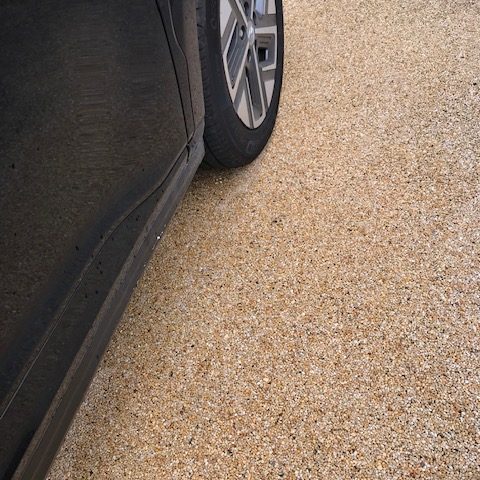
Other measures, in addition to reducing carbon emissions, need to be taken to both mitigate and adapt to climate change. When the driveway surface was renewed this year, the ‘Albedo’ or reflectiveness of the surface was considered. The new driveway, Fig.6., is a permeable gravel/resin in a beach sand colour, which not only reflects sunlight and heat, but is also a sustainable drainage system (SuDS) allowing rainwater to penetrate it in heavy rainfall events, alleviating local surface run-off. Whilst this does not reduce carbon and did not affect the results for lifestyle in the carbon footprint calculator (WWF, 2017), maintaining emissions at 0.5 tCO2, it is an important and necessary climate change adaptation for domestic dwellings.

Fig.6. The reflective sustainable drainage system (SuDS) driveway.

Infrastructure

The figure for infrastructure emissions in the carbon footprint calculator (WWF, 2017) remained at 2.75 tCO2 for each UK citizen. The annual donation to the Woodland Trust to plant 25 m2 of woodland, and the 14 trees planted off-set and sequester -1.14 tCO2 of these indirect emissions.

Behaviours

In September of this year, I began a Master’s Degree course in Sustainability in Energy Provision and Demand Management at the Graduate School of the Environment based at the Centre for Alternative Technology and University of East London. All previous behaviours continued, although more time was spent away from home for various reasons.

Conclusions

There was an overall emissions reduction of 4% or 0.2 tCO2e compared to the previous year, and 59% or 6.4 tCO2e compared to the baseline year. This was due to reductions in grid electricity consumption, despite lower solar generation, and in gas consumption, due mostly to a warmer spring, and water consumption remained the same as the previous year. However, vehicle travel emissions increased with an increase in mileage, although this was alleviated somewhat due to a lower emission factor for grid electricity as more renewable generators were again added to the mix. More time spent away from home accounted for the lower electricity consumption, increase in travel mileage, and some of the lower gas consumption.

References

The Department for Energy and Climate Change (2017). Greenhouse gas reporting – Conversion factors 2017. Available at: Greenhouse gas reporting: conversion factors 2017 – GOV.UK (www.gov.uk) (accessed January 2018).

WWF-UK (2018). Available at: WWF Footprint Calculator (accessed January 2018).

The Road to Carbon-Zero 2016  – Smashing the National Average  

Overview

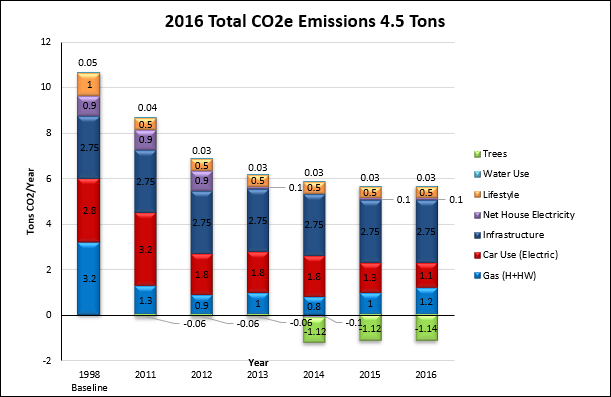
By 2016, all the main areas to reduce CO2 had been addressed. According to the WWF carbon calculator, per capita emissions for a UK citizen stood at 12.2 Tons per year, (WWF,2016). The changes made so far had delivered a 63% reduction to the annual national average, and a 58% or 6.2 tCO2e annual reduction to my baseline year at this point. All areas were stabilising at a lower level as was the total footprint at around 4.5 Tons per year, and there were no significant carbon reducing measures taken in 2016, although some small reductions were still achieved. The carbon fingerprint is shown in Fig.1. in comparison with previous years and baseline. 

Fig.1. The fingerprint of CO2e emissions in 2016, in comparison with previous years and baseline.

Solar Power Generation

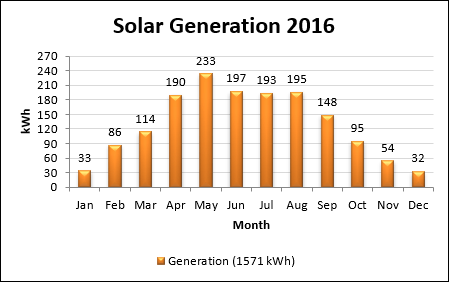
The total solar power generation for the year decreased by 72 kWh to 1541 kWh, derived from reading the generation meter. The monthly solar generation data are shown in Fig.2.

Fig.2. Monthly solar generation data.

Household Electricity Consumption

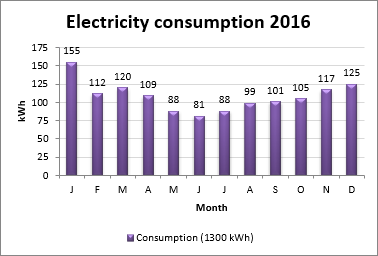
Total annual household electricity grid consumption was reduced on the previous year by 127 kWh or 9% to 1300 kWh, again derived from reading the electricity meter. The monthly grid electricity consumption data are shown in Fig.3.

Fig.3. Monthly grid electricity consumption data.

Using the assumption of 25% solar self-consumption, this year, 1300 kWh grid consumption minus 1156 kWh solar export resulted in a net grid electricity consumption of 144 kWh. Grid electricity was given a carbon intensity figure of 0.449 kgCO2e/kWh (DECC, 2016) for a 2016 generation mix. The combined solar self-consumption and exported generation resulted in an emission reduction of 44 kgCO2e to 65 kgCO2e, holding the footprint value at 0.1 tCO2e.

Space and Water Heating

Total annual household gas consumption increased by 20% on the previous year to 5914 kWh, derived from monthly meter readings, shown as a column chart in Fig.4. All consumption was provided by the gas grid, and given a carbon intensity figure of 0.204 kgCO2e/kWh (DECC, 2016). This resulted in an increase of 197kgCO2e to 1206 kgCO2e or 1.2 tCO2e emissions. As the chart shows, this increase was due to a cold start to the year and a cold spring season.

Fig.4. Monthly gas consumption data.

Car Travel

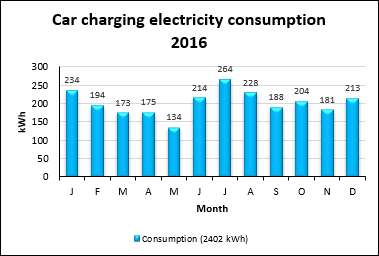
The car in use was a battery electric vehicle (BEV). The annual mileage estimated to the nearest 1000 decreased to 11000 miles, or 18000 km. As the fuel is electricity, the carbon intensity figure of fuel production and use in an electric vehicle is the same as is given for grid electricity, which this year was 0.449 kgCO2e/kWh (DECC, 2016) for a 2016 generation mix. The car consumed 2402 kWh of electricity to charge, derived from monthly readings of the night time consumption meter and shown as a column chart in Fig.5., resulting in fuel production emissions only of 1079 kgCO2e or 1.1 tCO2e.

Note: In the units previously given for vehicle emissions, 2016 grid electricity equates to 0.06 kgCO2e/km.

Fig.5. Monthly car charging data.

Water Consumption

Total annual household water consumption was reduced to 30 m3, derived from a utility bill for that year. The 2016 carbon intensity figure of domestic water supply (0.344 kgCO2e/m3), and treatment (0.708 kgCO2e/m3) is given as 1.052 kgCO2e/m3 (DECC, 2016). This resulted in a reduction of 2 kgCO2e to 32 kgCO2e, holding the footprint value at 0.03 tCO2e emissions.

Lifestyle

A small measure taken in this year, was the replacement of a petrol-powered lawn mower with a battery-powered robotic mower, pictured in Fig.6. The new device trimmed the large lawn using stored solar power generated by the rooftop array. The result being this was the last year that I had to purchase any petrol. This did not affect the results in the carbon footprint calculator (WWF, 2016), so emissions remained at 0.5 tCO2.

Fig.6. The robotic lawn mower in its charging station.

Infrastructure

The figure for infrastructure emissions in the carbon footprint calculator (WWF, 2016) remained at 2.75 tCO2 for each UK citizen. Two more trees were planted at home in this year, bringing the total to 14, and together with the annual donation to the Woodland Trust to plant 25 m2 of woodland, will off-set and sequester -1.14 tCO2 of these indirect emissions.

Behaviours

By this year, most of the behavioural changes to affect a more sustainable existence personally had taken place and were being maintained. However, through the charities that I was supporting, I began to be more active in political lobbying of my local representatives, to try to have a wider positive impact on environmental issues, such as climate change and carbon emission reduction. To help promote this, in May I joined Twitter at @EcofuturistUK.

Conclusions

There was an overall emissions reduction of 2% or 0.1 tCO2e compared to the previous year, and 58% or 6.2 tCO2e compared to the baseline year. There were reductions in grid consumption and vehicle travel emissions, in part due to a lower emission factor for grid electricity as more renewable generators were added to the mix. However, these were cancelled out by lower solar generation and higher gas consumption. There was also a slight decrease in water use, which does not show in the fingerprint.The actual difference between the 2015 and 2016 footprints was the 20 kgCO2 sequestered from the planting of two trees, and this resulted in a rounding down of the footprint by the 0.1 tCO2e figure.

References

The Department for Energy and Climate Change (2016). Greenhouse gas reporting – Conversion factors 2016. Available at: https://www.gov.uk/government/publications/greenhouse-gas-reporting-conversion-factors-2016 (accessed January 2017).

WWF-UK (2016). Available at: WWF Footprint Calculator (accessed January 2017).

The Road to Carbon-Zero 2015  – The Battery Electric Vehicle

Overview

At the end of 2014, the petrol hybrid vehicle was changed for a full battery electric vehicle (BEV), the Nissan Leaf (24kWh battery capacity), to further reduce travel emissions and eliminate tailpipe emissions completely. Electric vehicles are also an essential part of the sustainable energy transition, providing the storage of excess wind power generation, and reducing its curtailment as more is added to the grid system.

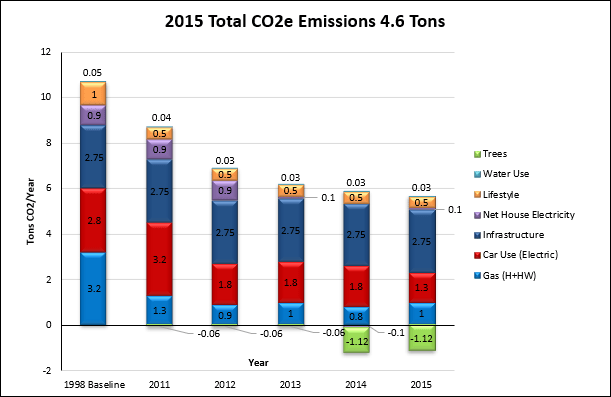
This 2nd generation of the first mass produced full BEV had a range of 90 miles on one charge. Although this range was low, crucially it enabled me to travel more miles at less cost with lower emissions. At the dwelling, the vehicle was charged on an economy seven tariff, ensuring lower cost, and charging during off-peak time at night when grid electricity is greener. The carbon fingerprint is shown in Fig.1. in comparison with previous years and baseline. 

Fig.1. The fingerprint of CO2e emissions in 2015, in comparison with previous years and baseline.

Solar Power Generation

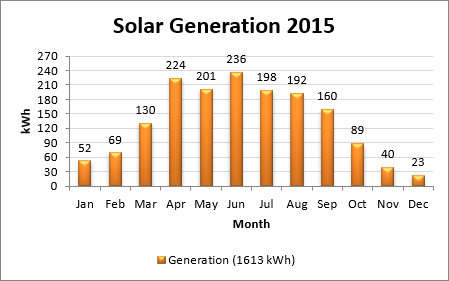
The total solar power generation for the year increased slightly by 20 kWh to 1613 kWh, derived from reading the generation meter. The monthly solar generation data are shown in Fig.2.

Fig.2. Monthly solar generation data.

Household Electricity Consumption

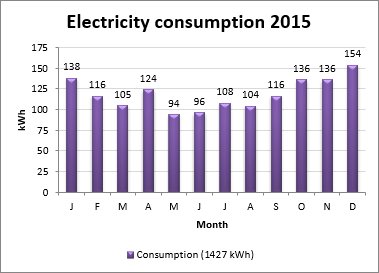
Total annual household electricity grid consumption increased on the previous year by 345 kWh or 32% to 1427 kWh, again derived from reading the electricity meter. The monthly grid electricity consumption data are shown in Fig.3.

Fig.3. Monthly grid electricity consumption data.

Using the assumption of 25% solar self-consumption, 1427 kWh grid consumption minus 1210 kWh solar export resulted in a net grid electricity consumption of 217 kWh. Grid electricity was given a carbon intensity figure of 0.5 kgCO2e/kWh (DECC, 2015) for a 2015 generation mix. This resulted in an emission increase of 170 kgCO2e to 109 kgCO2e or 0.1 tCO2e.

Space and Water Heating

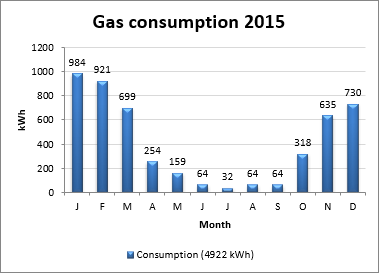
Total annual household gas consumption increased by 21% to a more typical level of 4922 kWh, compared to the previous year’s low, derived from monthly meter readings, shown as a column chart in Fig.4. All consumption was provided by the gas grid, and given a carbon intensity figure of 0.205 kgCO2e/kWh (DECC, 2015). This resulted in an increase of 172kgCO2e to 1009 kgCO2e or 1.0 tCO2e emissions.

Fig.4. Monthly gas consumption data.

Car Travel

Fig.5. The Battery Electric Nissan Leaf.

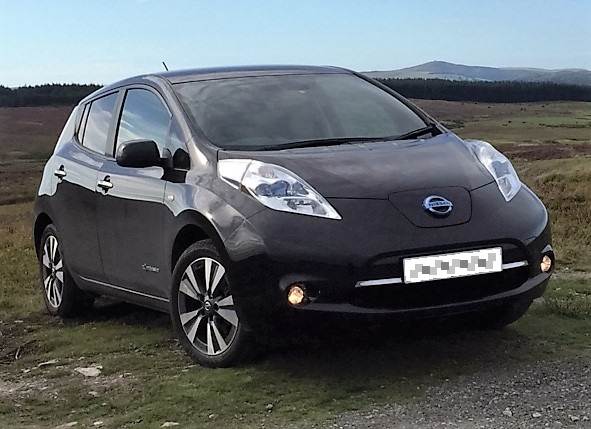
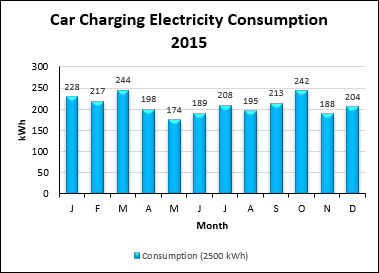
The car in use was now a battery electric vehicle (BEV), shown in Fig.5. The annual mileage had also increased by 50% in this year, and estimated to the nearest 1000 was given as 12000 miles, or 19000 km. As the fuel is electricity, the carbon intensity figure of fuel production and use in an electric vehicle is the same as is given for grid electricity, which this year was 0.5 kgCO2e/kWh (DECC, 2015) for a 2015 generation mix. The car consumed 2500 kWh of electricity to charge, derived from monthly readings of the night time consumption meter and shown as a column chart in Fig.6. This resulted in fuel production emissions only, and a reduction of 31% or 570 kgCO2e to 1250 kgCO2e or 1.3 tCO2e.

Notes: Had the mileage remained at 8000 miles, the emission value would have been reduced by 54% to 833 kgCO2e. In the units previously given for vehicle emissions, 2015 grid electricity equates to 0.066 kgCO2e/km.

Fig.6. Monthly car charging data.

Water Consumption

Total annual household water consumption increased by 33% to 32 m3, derived from a utility bill for that year. The 2015 carbon intensity figure of domestic water supply (0.344 kgCO2e/m3), and treatment (0.709 kgCO2e/m3) is given as 1.053 kgCO2e/m3 (DECC, 2015). This resulted in an emission increase of 9 kgCO2e to 34 kgCO2e, holding the fingerprint value at 0.03 tCO2e.

Lifestyle

The energy supplier was changed to a different 100% renewable generator, Ecotricity. This provided a better tariff for charging the BEV, and enabled investment in a green bond to fund building of new renewable generation assets like wind and solar farms. A further investment was made in Thrive Renewables for the same reason. These did not affect the results for lifestyle in the carbon footprint calculator (WWF, 2016), so emissions remained at 0.5 tCO2.

Infrastructure

The figure for infrastructure emissions in the carbon footprint calculator (WWF, 2016) remained at 2.75 tCO2 for each UK citizen. The annual donation to the Woodland Trust to plant 25 m2 of woodland, and the 12 trees planted off-set and sequester -1.12 tCO2 of these indirect emissions.

Behaviours

The travel mileage had increased as more time was spent away from home on work placements. Household electricity use increased, possibly due to less time available to use solar power for clothes and dishwashing due to being out during the daytime, and some unintended charging of the EV outside of the off-peak period.

Conclusions

There was an overall emissions reduction of 2% or 0.1 tCO2e compared to the previous year, and 57% or 6.1 tCO2e compared to the baseline year. This was mostly due to the reduction in travel emissions of 0.5 tCO2e, however this reduction was limited by a 50% increase in vehicle mileage, and increases in grid electricity use and gas consumption emissions both of 0.2 tCO2e. There was a further, slight increase in water use, which does not show in the fingerprint. 

References

The Department for Energy and Climate Change (2015). Greenhouse gas reporting – Conversion factors 2015. Available at: https://www.gov.uk/government/publications/greenhouse-gas-reporting-conversion-factors-2015 (accessed 05 August 2016).

WWF-UK (2016). Available at: WWF Footprint Calculator (accessed 05 August 2016).

The Road to Carbon-Zero 2014 – Natural Carbon Capture

Overview

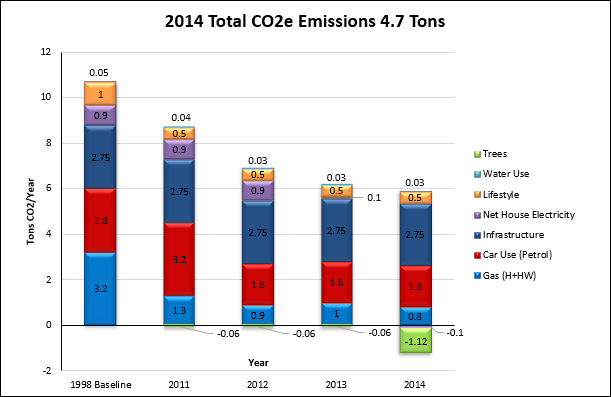
I graduated this year from the Open University with a BSc Environmental Studies and Diploma in Environmental Policy, as a mature student aged 40. Over the previous three years, the action taken to reduce carbon dioxide emissions in the four main areas of electricity use, space heating and hot water, travel, and lifestyle, resulted in an annual reduction of 43% or 4.6 tCO2e. However, whilst good progress had been made in reducing these direct emissions, there remained a substantial contribution to the footprint from the indirect emissions from infrastructure. These emissions could only be reduced by off-setting, and so it was decided to increase the contribution of natural carbon capture and storage, or sequestration, through planting a further six trees at home and donating money each year to plant a further 25 m2 of woodland. The carbon fingerprint is shown in Fig.1. in comparison with previous years and baseline. 

Fig.1. The fingerprint of CO2e emissions in 2014, in comparison with previous years and baseline.

Solar Power Generation

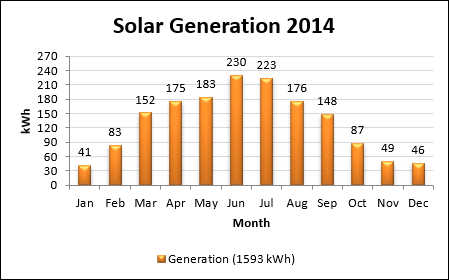
The total solar power generation for the year increased slightly by 16 kWh to 1593 kWh, derived from reading the generation meter. The monthly solar generation data are shown in Fig.2.

 Fig.2. Monthly solar generation data.

Household Electricity Consumption

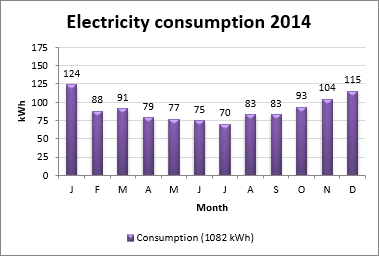
Total annual household electricity grid consumption was reduced on the previous year by 20% or 271 kWh to 1082 kWh, again derived from reading the electricity meter. The monthly grid electricity consumption data are shown in Fig.3.

Fig.3. Monthly grid electricity consumption data.

Using the assumption of 25% solar self-consumption, this year 1082 kWh grid consumption minus 1195 kWh solar export resulted in a net grid electricity export of 113 kWh. Grid electricity was given a carbon intensity figure of 0.537 kgCO2e/kWh (DECC, 2014) for a 2014 generation mix. The combined solar self-consumption and exported generation resulted in an emissions reduction on the previous year of 144 kgCO2e to -61 kgCO2e or -0.1 tCO2e.

Space and Water Heating

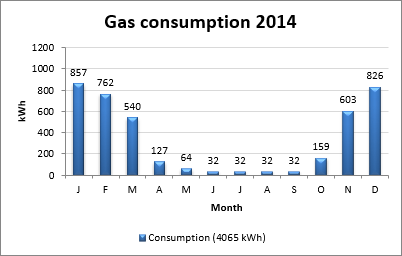
Due to very mild winter weather conditions, total annual household gas consumption decreased by 20% on the previous year to 4065 kWh, the lowest value so far, derived from monthly meter readings, shown as a column chart in Fig.4. All consumption was provided by the gas grid, and given a carbon intensity figure of 0.206 kgCO2e/kWh (DECC, 2014). This resulted in a decrease of 210kgCO2e to 837 kgCO2e or 0.8 tCO2e emissions.

Fig.4. Monthly gas consumption data.

Car Travel

The vehicle in use remained a mid-sized 1.6 litre petrol hybrid. The estimated annual mileage to the nearest 1000 was given as 8000 miles, or 13000 km. The carbon intensity figure of petrol fuel production and use in a hybrid vehicle is given as 0.14 kgCO2e/km (DECC, 2012). This resulted in emissions remaining at 1.8 tCO2e.

Water Consumption

A 300-litre water butt was installed to collect rainwater from the main house roof for later use in the garden, and watering houseplants. Total annual household water consumption was reduced by 11% to 24 m3, derived from a utility bill for that year. The 2014 carbon intensity figure of domestic water supply (0.344 kgCO2e/m3), and treatment (0.709 kgCO2e/m3) is given as 1.053 kgCO2e/m3 (DECC, 2014). This resulted in an emissions reduction of 3 kgCO2e to 25 kgCO2e, holding the fingerprint value at 0.03 tCO2e.

Lifestyle

An extremely inefficient LCD television was replaced with a more efficient LED TV at the beginning of this year. The new TV was Ten-times more efficient, reducing the power output from 350 Watts to just 35 Watts. This was the likely reason for the 20% reduction in grid electricity demand. The old TV was sold to a second-hand store.

My savings were moved to ethical bank Triodos, to ensure my money was only being invested in environmentally and socially positive, sustainable projects. I also became a member and supporter of the Centre for Alternative Technology in Machynlleth, Wales.

These did not affect the results for lifestyle in the carbon footprint calculator (WWF, 2016), so emissions remained at 0.5 tCO2.

Infrastructure

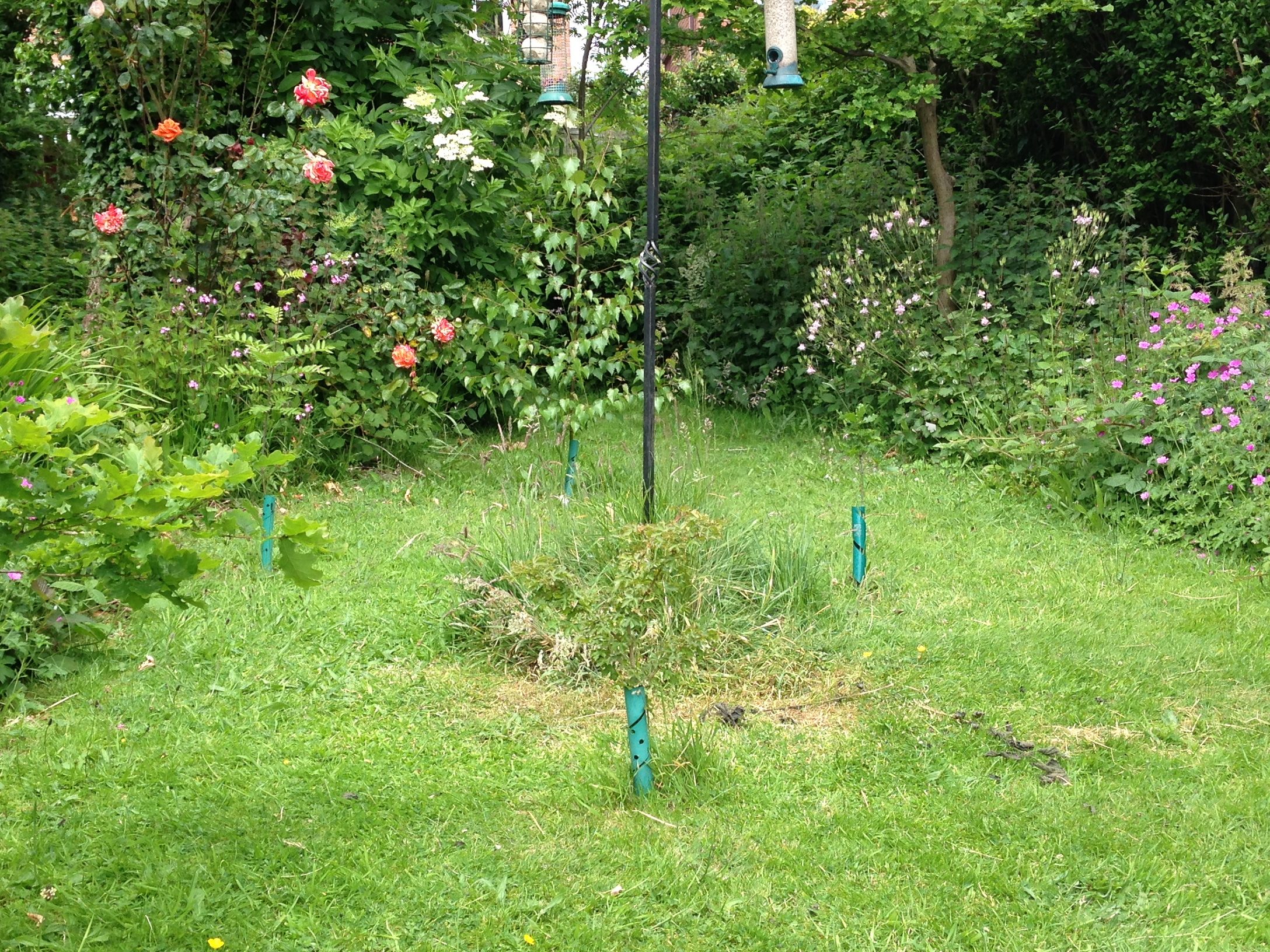
The figure for infrastructure emissions in the carbon footprint calculator (WWF, 2016) remained at 2.75 tCO2 for each UK citizen. Six more trees were planted, some are shown in Fig.5., and money donated annually to the Woodland Trust to plant 25 m2 of woodland to off-set a further 1.06 tCO2 of these infrastructure emissions. Together with the 0.06 tCO2 sequestered each year by the six trees planted in 2011, this resulted in sequestration of -1.12 tCO2 in the fingerprint. This action also has an additional positive effect by increasing biodiversity.

Fig.5. Four of the six newly planted trees. (Clockwise from left) Rowan, Silver Birch, Oak, and Field Maple.

Behaviours

With a new understanding of the electricity grid and my solar generation, I began to change behaviour around electricity use. Making the most of the solar generation by doing clothes washing and using the dishwasher when the solar PV system was producing peak power. I also began delaying cooking my evening meals until 7.30 pm. This reduces carbon emissions by reducing the amount of fossil-fuelled power needed to meet the evening peak electricity demand between 4pm and 7.30pm.

Conclusions

There was an overall emissions reduction of 23% or 1.4 tCO2e compared to the previous year, and 56% or 6 tCO2e compared to the baseline year. This was mostly due to off-set infrastructure emissions of 1.06 tCO2e by natural sequestration from tree planting. Contributions also came from net grid electricity export, and a weather-related decrease in gas consumption further reducing emissions by 0.1 tCO2e and 0.2 tCO2e, respectively. There was a further, slight reduction in water use which does not show in the fingerprint. 

References

The Department for Energy and Climate Change (2014). Greenhouse gas reporting – Conversion factors 2014. Available at: https://www.gov.uk/government/publications/greenhouse-gas-reporting-conversion-factors-2014 (accessed 05 August 2016).

The Department for Energy and Climate Change and The Department for Environment, Food and Rural Affairs (2012). 2012 Guidelines to Defra / DECC’s GHG Conversion Factors for Company Reporting. Table 6d. Available at: pb13773-ghg-conversion-factors-2012.pdf (publishing.service.gov.uk) (accessed 05 August 2016).

WWF-UK (2016). Available at: WWF Footprint Calculator (accessed 05 August 2016).

The Road to Carbon-Zero 2013 – Solar, So Good

Overview

With a 41% reduction in carbon emissions per year already achieved from space and water heating, car use, and electrical efficiency, the focus turned to reducing electrical demand from the grid. With the help of a government incentive, the Feed-in-Tariff (FiT), it became financially viable to install a solar system. In November 2012, a 1.8 kWp (kiloWattpeak) solar photovoltaic array was installed on the south-east facing roof of the property, consisting of eight 230-Watt polycrystalline silicon modules. The system was predicted by the installer to produce 1472 kWh of zero-carbon electricity per year, of which approximately one-quarter would be self-consumed, and the rest exported to the grid.

Further improvements to thermal efficiency were also made in September of this year, in the form of A-rated, argon-filled, double-glazed windows with a low emissivity coating which traps heat in and maximises passive solar gain. The carbon fingerprint is shown in Fig.1. in comparison with previous years and baseline. 

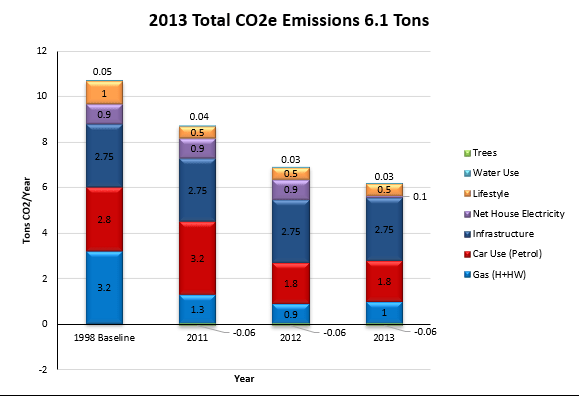
Fig.1. The fingerprint of CO2e emissions in 2013, in comparison with previous years and baseline.

Solar Power Generation

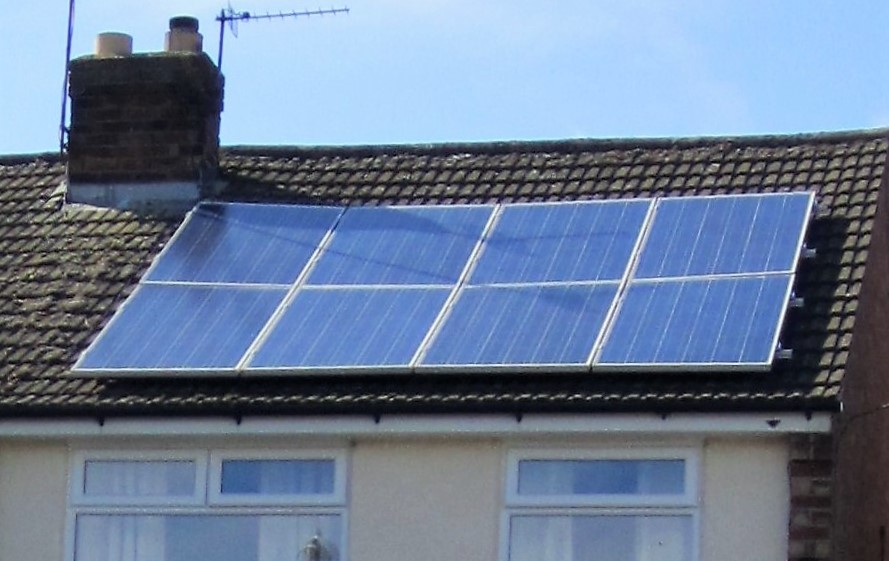
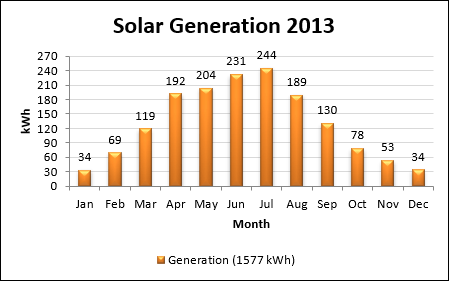
The solar array, shown in Fig.2., reached the predicted generation value on September 22nd, with a full quarter of the year still to go. The total generation for the year was 1577 kWh, derived from reading the generation meter. The monthly solar generation data are shown in Fig.3.

Fig.2. The 1.8 kWp Solar Photovoltaic rooftop array on my home.

Fig.3. Monthly solar generation data.

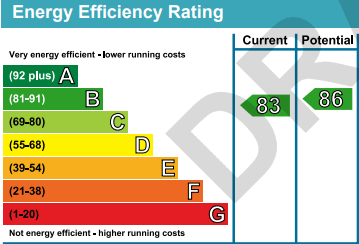
Furthermore, the solar PV system installation improved the Energy Performance Certificate (EPC) value from Band C (Rating 73) to Band B (Rating 83), shown in Fig.4.

Fig.4. A draft EPC showing the new current energy efficiency rating of the building.

Household Electricity Consumption

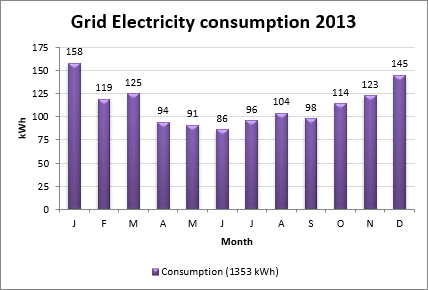
Total annual household electricity grid consumption was reduced on the previous year by 23% or 403 kWh to 1353 kWh, again derived from reading the electricity meter. The monthly grid electricity consumption data are shown in Fig.5. However, a new approach was now needed to work out the CO2e emissions.

Fig.5. Monthly grid electricity consumption data.

The methodology to determine the net CO2e emissions from electricity use is worked as follows, using the data from this first year of solar generation. The predicted solar self-consumption of 25% of total generation would be 394 kWh, very close to the electricity grid consumption reduction of 403 kWh. Working on the assumptions that overall household electrical demand was similar, but slightly lower, to the previous year, and all electricity grid consumption reduction was a result of solar generation, this then leaves 75% or 1183 kWh of solar generation exported to the grid. This exported generation removes the equivalent amount having to be generated by the electricity grid, off-setting household electricity consumed from the grid, at night for example.

This year, 1353 kWh consumed minus 1183 kWh exported resulted in a net grid electricity consumption of 170 kWh. Grid electricity was given a carbon intensity figure of 0.484 kgCO2e/kWh (DECC, 2013) for a 2013 generation mix. The combined solar self-consumption and exported generation resulted in a 91% emissions reduction compared to the previous pre-solar year of 789 kgCO2e to 82 kgCO2e or 0.1 tCO2e.

Note: This is a very simplified method, and is used because the data sources i.e., meter readings, are very basic. It is however, considered appropriate for the illustrative purposes and scope of this work.

Space and Water Heating

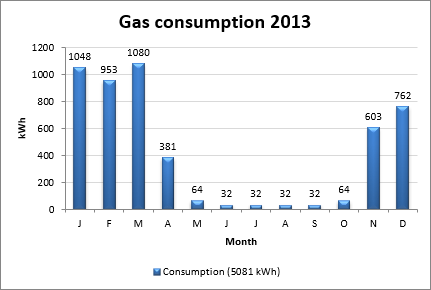
Due to colder winter weather conditions, total annual household gas consumption increased by 17% on the previous year to 5081 kWh, derived from monthly meter readings, despite the thermal improvement of the glazing. The monthly gas consumption data are shown as a column chart in Fig.6., and the effect of the new windows can be seen in the lower gas consumption during the winter months at year end when compared to those at the beginning of the year. All consumption was provided by the gas grid, and given a carbon intensity figure of 0.206 kgCO2e/kWh (DECC, 2012). This resulted in an increase of 153kgCO2e to 1047 kgCO2e or 1.0 tCO2e emissions.

Fig.6. Monthly gas consumption data.

Car Travel

The vehicle in use remained a mid-sized 1.6 litre petrol hybrid. The estimated annual mileage to the nearest 1000 was given as 8000 miles, or 13000 km. The carbon intensity figure of petrol fuel production and use in a hybrid vehicle is given as 0.14 kgCO2e/km (DECC, 2012). This resulted in emissions remaining at 1.8 tCO2e.

Water Consumption

Total annual household water consumption was reduced by 16% to 27 m3, derived from a utility bill for that year. The 2012 carbon intensity figure of domestic water supply (0.344 kgCO2e/m3), and treatment (0.709 kgCO2e/m3) is given as 1.053 kgCO2e/m3 (DECC, 2013). This resulted in a reduction of 6 kgCO2e to 28 kgCO2e, holding the fingerprint value at 0.03 tCO2e emissions.
Lifestyle

The firm providing energy to the home was changed at the beginning of the year, from one of the ‘big six’ to one of the two 100% renewable energy providers in the UK, Good Energy. They would also provide the FiT payments for solar power generation. Although it is a better lifestyle choice to support the building of new renewable energy sources through supporting these suppliers, this did not affect the results for lifestyle in the carbon footprint calculator (WWF, 2016), so emissions remained at 0.5 tCO2.

Infrastructure

The figure for infrastructure emissions in the carbon footprint calculator (WWF, 2016) remained at 2.75 tCO2 for each UK citizen. Again, a value of -0.06 tCO2 was attributed to the natural sequestration of CO2 by the six trees planted in 2011.

Behaviours

Beginning this year, meter readings were now being taken monthly and logged, for solar generation, electricity grid consumption and gas consumption.

Conclusions

There was an overall emissions reduction of 10% or 0.7 tCO2e compared to the previous year, and 43% or 4.6 tCO2e compared to the baseline year. This was exclusively due to reduced emissions of 0.8 tCO2e from net grid electricity consumption, because of solar power generation. A slight weather-related increase in gas consumption reduced the margin by 0.1 tCO2e. There was a further, slight reduction in water use, and a CO2 reducing lifestyle choice that do not show in the footprint. 

Importantly, the change to a 100% renewable energy supplier was not used to give a zero-emission factor for electricity grid consumption in the footprint. It was decided, using the yearly emission factors of the mix of generation provided a true representation of CO2 emissions in this category.

References

The Department for Energy and Climate Change (2013). Greenhouse gas reporting – Conversion factors 2013. Available at: https://www.gov.uk/government/publications/greenhouse-gas-reporting-conversion-factors-2013 (accessed 05 August 2016)
The Department for Energy and Climate Change and The Department for Environment, Food and Rural Affairs (2012). 2012 Guidelines to Defra / DECC’s GHG Conversion Factors for Company Reporting. Table 6d. Available at: pb13773-ghg-conversion-factors-2012.pdf (publishing.service.gov.uk) (accessed 05 August 2016).

WWF-UK (2016). Available at: WWF Footprint Calculator (accessed 05 August 2016).

The Road to Carbon-Zero 2012 – Beyond Kyoto with a Petrol Hybrid Car

Overview

The measures implemented by the end of 2011 are achievable in most homes, especially with funding from government, and this demonstrates that just implementing the less expensive measures can achieve a 20% reduction in carbon emissions. To put this in context, the UK national carbon emission reduction target by 2020 under the Kyoto protocol and EU emission target was 20% below the 1990 baseline year (UNFCCC, 2012).

However, the carbon fingerprint highlights there were further reductions to be made. With the lowest cost measures having been taken to reduce emissions from the property, with significant effect, it was time to focus on reducing travel emissions. The carbon fingerprint is shown in Fig.1. in comparison with the previous year and baseline. 

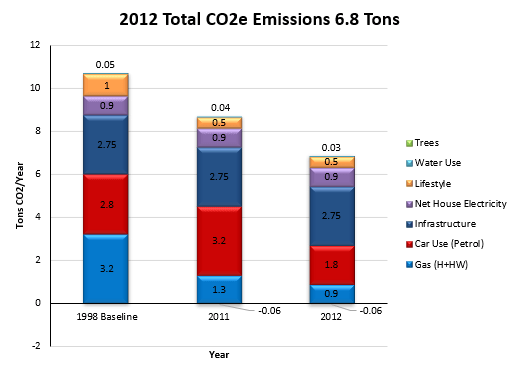
Fig.1. The fingerprint of CO2e emissions in 2012, in comparison with the previous year and baseline.

Household Electricity Consumption

Total annual household electricity consumption slightly increased on the previous year by 1% to 1756 kWh, derived from a utility bill for that year. All consumption was provided by the electricity grid and given a carbon intensity figure of 0.496 kgCO2e/kWh (DECC, 2013) for a 2012 generation mix. This resulted in an increase of 17 kgCO2e to 871 kgCO2e, holding the fingerprint value at 0.9 tCO2e emissions.

Space and Water Heating

No further improvements to thermal efficiency were made this year. However, due to milder winter weather conditions and less hot water demand, total annual household gas consumption was reduced by 29% on the previous year to 4342 kWh, derived from a utility bill for that year. All consumption was provided by the gas grid and given a carbon intensity figure of 0.206 kgCO2e/kWh (DECC, 2012). This resulted in a reduction of 368 kgCO2e to 894 kgCO2e or 0.9 tCO2e emissions.

An Energy Performance Certificate (EPC) survey was undertaken in October of this year to provide a value of energy performance for the building. This was needed in preparation for a solar PV system installation. The result was a value of Band C (Rating 73), shown in Fig.2.

Fig.2. The EPC showing the current energy efficiency rating of the building.

Car Travel

At the end of 2011, the vehicle in use was changed to a mid-sized 1.6 litre petrol hybrid, pictured in Fig.3. With the new breed of battery electric vehicles still in their infancy, and prohibitively expensive, this was the best option at the time. The estimated annual mileage to the nearest 1000 was given as 8000 miles, or 13000 km. The carbon intensity figure of petrol fuel production and use in a hybrid vehicle is given as 0.14 kgCO2e/km (DECC, 2012). This resulted in a 44% reduction of 1417 kgCO2e to 1820 kgCO2e or 1.8 tCO2e emissions.

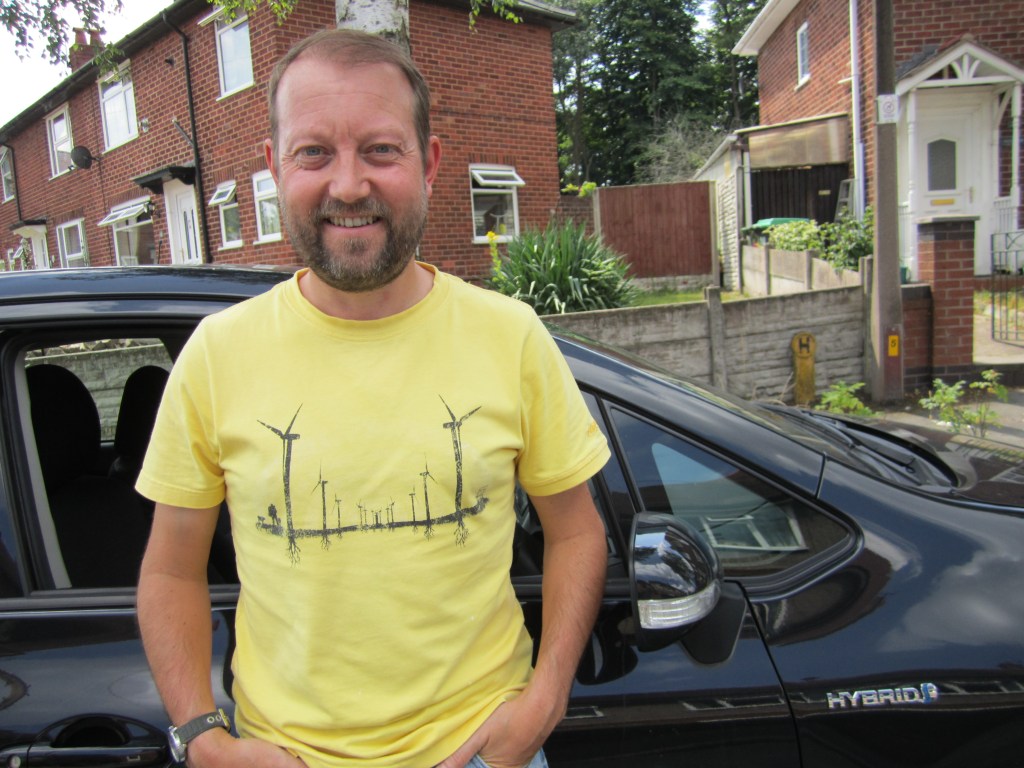
Fig.3. Myself with the Toyota Auris petrol hybrid car.

Water Consumption

This year a water meter was installed at the property. Total annual household water consumption was reduced by 16% to 32 m3, derived from a utility bill for that year. The 2012 carbon intensity figure of domestic water supply (0.344 kgCO2e/m3), and treatment (0.709 kgCO2e/m3) is given as 1.053 kgCO2e/m3 (DECC, 2013). This resulted in a reduction of 6 kgCO2e to 34 kgCO2e or 0.03 tCO2e emissions.

Lifestyle

There were no changes to the previous year, so emissions remained at 0.5 tCO2.

Infrastructure

The figure for infrastructure emissions in the carbon footprint calculator (WWF, 2016) remained at 2.75 tCO2 for each UK citizen, and a value of -0.06 tCO2 was attributed to the natural sequestration of CO2 by the six trees planted in 2011.

Behaviours

Occupancy remained the same as the previous year, however more vigilance was observed with water use, with the installation of the water meter. This clearly reduced water use, but also reduced gas consumption for water heating, as showers were now taken more often than a bath.

Conclusions

There was an overall emissions reduction of 21% or 1.8 tCO2e compared to the previous year, and 41% or 3.9 tCO2e compared to the baseline year. This was primarily due to reduced car-fuel consumption, from the decreased emission factor in the production and use of petrol in a hybrid drivetrain vehicle. The difference between a two-litre petrol car compared to a 1.6 litre hybrid car was an impressive 1.4 tCO2e/year when driving the same mileage. There was a further contribution from reduced gas consumption, although this was mostly weather related, and another small contribution from reduced water use.

References

The Department for Energy and Climate Change (2013). Greenhouse gas reporting – Conversion factors 2012. Available at: https://www.gov.uk/government/publications/greenhouse-gas-reporting-conversion-factors-2012

The Department for Energy and Climate Change and The Department for Environment, Food and Rural Affairs (2012). 2012 Guidelines to Defra / DECC’s GHG Conversion Factors for Company Reporting. Table 6d. Available at: pb13773-ghg-conversion-factors-2012.pdf (publishing.service.gov.uk) (accessed 05 August 2016).

WWF-UK (2016). Available at: WWF Footprint Calculator (accessed 05 August 2016).

UNFCCC (2012). Doha Amendment to The Kyoto Protocol Doha, 8 December 2012. Available at: Microsoft Word – wtp1356369662324.doc (un.org) (accessed 04 November 2022).

The Road to Carbon-Zero 2011 – The First Steps

Overview

In 2005, before consciously reducing my carbon footprint, the house was extensively refurbished. The front and patio doors were replaced with new standard PVCu units with thermal values of the time, the side door was removed and bricked up, the flat roof extension roof was replaced, re-insulated and covered with a rubber membrane, the loft was insulated to 150 mm with wool fibre and the old inefficient boiler was replaced with a 90% efficient gas condensing boiler, new pipework, and radiators. This improved the thermal efficiency of the building when compared to the baseline year. The electrics were rewired and there were also new electrical additions in the form of a desktop PC and a dishwasher, and an old washing machine was replaced.

In 2011, the first low-cost measures were introduced to further improve the thermal efficiency of the building and its energy and water consumption. The carbon fingerprint is shown in Fig.1. in comparison to the baseline. 

Fig.1. The fingerprint of CO2e emissions in 2011, in comparison with the baseline.

Household Electricity Consumption

Initially, an energy monitor was used to find where consumption could be reduced. LED bulbs were installed throughout the house which use 90% less power than the incandescent or halogen bulbs they replaced. Investments were made in an eco-kettle which can boil just a single cup, and a slow cooker. Effort was also made to ensure appliances were never left on standby.

Total annual household electricity consumption was slightly reduced by 2% to 1739 kWh, derived from a utility bill for that year. All consumption was provided by the electricity grid and given a carbon intensity figure of 0.491 kgCO2e/kWh (DECC, 2013) for a 2011 generation mix. This resulted in a reduction of 65 kgCO2e to 854 kgCO2e, holding the fingerprint value at 0.9 tCO2e emissions.

Space and Water Heating

To further reduce building fabric heat loss, loft insulation was increased to 300 mm with wool fibre, and cavity wall insulation was installed. Areas where air was escaping, gaps under skirting boards for example, were also sealed. Importantly, the insulation was funded by a Welsh Government grant available at the time, which was much appreciated.

These measures reduced total annual household gas consumption by 61% to 6127 kWh, again derived from a utility bill for that year. All consumption was provided by the gas grid and given a carbon intensity figure of 0.206 kgCO2e/kWh (DECC, 2012). This resulted in a reduction of 1973 kgCO2e to 1262 kgCO2e or 1.3 tCO2e emissions.

Car Travel

The vehicle in use was a mid-sized 2.0 litre petrol. The estimated annual mileage to the nearest 1000 was given as 8000 miles, or 13000 km. The carbon intensity figure of petrol fuel production and use is given as 0.249 kgCO2e/km (DECC, 2012). This resulted in a 15% increase of 468 kgCO2e to 3237 kgCO2e or 3.2 tCO2e emissions.

Water Consumption

At this time there was no water meter installed at the property. Some low-flow gadgets were installed on taps, and hippos placed in the two toilet cisterns. Total annual household water consumption was reduced by 24% to 38 m3, again derived from a utility bill for that year. The 2011 carbon intensity figure of domestic water supply (0.344 kgCO2e/m3), and treatment (0.709 kgCO2e/m3) is given as 1.053 kgCO2e/m3 (DECC, 2012). This resulted in a reduction of 8 kgCO2e to 40 kgCO2e or 0.04 tCO2e emissions.

Lifestyle

Conscious changes to my lifestyle began in this year.  Food was top of the list, I removed red meat and reduced dairy in my diet, started buying organic, fresh, seasonal food from local farm shops where possible, and only sustainably caught fish. I started supporting environmental charities Greenpeace, and Friends of the Earth, already a supporter of RSPB, and made much more effort to live by the three R’s, Reduce, Re-use and Recycle.

These changes were put into the carbon footprint calculator (WWF, 2016), and a figure was given for a low consumption lifestyle but with some conscious decisions around ethics and low-impact diet. This resulted in a 50% reduction to 0.5 tCO2 emissions.

Infrastructure

The figure for infrastructure emissions in the carbon footprint calculator (WWF, 2016) remained at 2.75 tCO2 for each UK citizen. However, whilst these emissions cannot be controlled directly, they can be off set through the natural sequestration of CO2 through tree planting. This year I planted six native trees in the garden. The principle I use is that, according to the Woodland Trust, each tree will absorb one ton of CO2 during a 100-year lifetime, which gives a value of 10 kg per year, although trees absorb more CO2 as they mature and less in the early years. This gives a value of -0.06 tCO2 in the fingerprint.

Behaviours

By this year the house was occupied most of the time, whilst I studied by distance learning from home, in contrast to occupancy in the baseline year. Because of this, there was inevitably some ‘rebound effect,’ as some of the energy efficiencies made were absorbed by increased consumption patterns.

Conclusions

There was an overall emissions reduction of 20% or 2.1 tCO2e compared to the baseline year. This mostly came from the greater efficiency of the heating system, but also thermal improvements to the building fabric, through insulation and improved airtightness, with smaller contributions from lifestyle choices and water use. Electricity consumption was also reduced however the reduction was small due to increases in consumption from more appliances and hours of occupancy. Furthermore, the reduction in emissions would have been greater but were countered by the increased emission factor in the production and use of petrol for car fuel compared to diesel.    

References

The Department for Energy and Climate Change (2013). Greenhouse gas reporting – Conversion factors 2011. Available at: Greenhouse gas reporting – Conversion factors 2011 – GOV.UK (www.gov.uk) (accessed 05 August 2016).

The Department for Energy and Climate Change and The Department for Environment, Food and Rural Affairs (2012). 2012 Guidelines to Defra / DECC’s GHG Conversion Factors for Company Reporting. Table 1d. Available at: pb13773-ghg-conversion-factors-2012.pdf (publishing.service.gov.uk) (accessed 05 August 2016).

The Department for Energy and Climate Change and The Department for Environment, Food and Rural Affairs (2012). 2012 Guidelines to Defra / DECC’s GHG Conversion Factors for Company Reporting. Table 6b. Available at: pb13773-ghg-conversion-factors-2012.pdf (publishing.service.gov.uk) (accessed 05 August 2016).

The Department for Energy and Climate Change and The Department for Environment, Food and Rural Affairs (2012). 2012 Guidelines to Defra / DECC’s GHG Conversion Factors for Company Reporting. Table 9a. Available at: pb13773-ghg-conversion-factors-2012.pdf (publishing.service.gov.uk) (accessed 05 August 2016).

WWF-UK (2016). Available at: WWF Footprint Calculator (accessed 05 August 2016).

The Road to Carbon-Zero 2010 – The Beginning

Overview

In 2010, I decided to begin making the transition from business-as-usual to a low-carbon, sustainable existence. It was then, and still remains, important to do this to try to mitigate the worst effects of human-caused climate change, the biggest threat to humanity and all life on Earth, to be part of the solution, and one less part of the problem. To achieve this, we can reduce the carbon dioxide emissions from our activities by focussing on four areas: space and water heating, electricity consumption, transport, and lifestyle. We can also reduce our impact on natural systems by reducing water use, planting trees, and increasing green space for biodiversity.

Setting a baseline

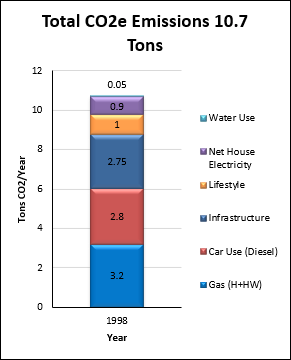
It would be nice to live in a zero-carbon eco-house, built for the purpose of living a reduced carbon-emitting lifestyle. However, the reality is that most of us will have to work with what we already have, in this case a 1960’s three-bedroom semi-detached house. The first step is to understand exactly what our energy usage is. This can be done through a combination of looking at old utility bills, and taking meter readings for electricity, gas, and water; the mpg consumption and annual mileage of a car; and using data from a carbon footprint calculator for lifestyle and infrastructure values. Through this process and using Carbon Dioxide (CO2) emission factors from reliable sources, a representation of the CO2 fingerprint and total footprint can be formed for a baseline year to measure improvements against, in my case this was 1998, shown in Fig.1.

Fig.1. The fingerprint of CO2e emissions in the 1998 baseline year.

Notes:

The emission factors are given as kgCO2e (kilograms carbon dioxide equivalent) which include emissions of carbon dioxide (CO2), methane (CH4) and nitrous oxide (N2O), except those from the WWF carbon footprint calculator.

The emission factors were updated, and WWF carbon footprint calculator values added in 2016.

Household Electricity Consumption

The lights in the house at that time used incandescent bulbs. Appliances were relatively new and had the efficiencies of their time. There was no home computer, tumble dryer, or dishwasher, but apart from those the home had all the usual electrical appliances needed for it to function. 

Total annual household electricity consumption was 1771 kWh (kiloWatt hours), derived from an old utility bill from that year. All consumption was provided by the electricity grid and given a carbon intensity figure of 0.519 kgCO2e/kWh for a 1998 generation mix (DECC, 2012). This resulted in 919 kg or 0.9 tCO2e emissions.

Space and Water Heating

This was provided by a 1970’s gas-fired central heating boiler and radiators, very inefficient by modern standards. This was also not a thermally efficient building. There was a thin 2 cm vermiculite insulation layer in the loft, no cavity wall insulation, 1980’s double-glazed aluminium framed windows and patio doors, and leaky wooden front and side doors. Hot water was provided by the boiler on demand.

Total annual household gas consumption was 15704 kWh, again derived from an old utility bill from that year. All consumption was provided by the gas grid and given a carbon intensity figure of 0.206 kgCO2e/kWh (DECC, 2012). This resulted in 3235 kg or 3.2 tCO2e emissions.

Car Travel

The vehicle in use was a mid-sized 1.9 litre diesel. The estimated annual mileage to the nearest 1000 was given as 8000 miles, or 13000 km. The carbon intensity figure of diesel fuel production and use is given as 0.213 kgCO2e/km (DECC, 2012). This resulted in 2769 kg or 2.8 tCO2e emissions.

Water Consumption

At this time there was no water meter installed at the property. Total annual household water consumption was 50 m3, again derived from an old utility bill from that year. The carbon intensity figure of domestic water supply (0.276 kgCO2e/m3), and treatment (0.693 kgCO2e/m3) is given as 0.969 kgCO2e/m3 (DECC, 2012). This resulted in 48 kg or 0.05 tCO2e emissions.

Note: These figures relate to 2007/2008, as the nearest year available.

Lifestyle

These emissions come from our lifestyle choices such as type, consumption, production, and origin of goods like clothes, devices, food and energy, and the ethics or Corporate Social Responsibility (CSR), also known as Environmental, Social and Governance (ESG) of companies we use to provide these.

This figure was derived from an online carbon footprint calculator by the World Wildlife Fund (WWF, 2016), whereby a figure is given depending on the inputs we give as to our lifestyle choices. More environmental and ethical choices give a lower score. A figure was given for a low consumption lifestyle but with few conscious decisions around ethics and low-impact diet. This resulted in 1 tCO2 emissions.

Infrastructure

The infrastructure we use like services, roads, hospitals etc., also have CO2 emissions attributed to them. The major difference with these emissions compared to the other components is that they are not personally controllable, and therefore remain constant over the monitoring period. Infrastructure processes are generally carbon intensive, with little room to reduce the associated emissions. They are attributed to everyone as a proportion of the total emissions for the whole of the UK. The figure was derived from the same carbon footprint calculator (WWF, 2016), and results in 2.75 tCO2 for each UK citizen.

Behaviours

During the baseline year, occupancy was extremely low, with me being out at work for most of the day during the week, and at leisure at weekends. This resulted in very low consumption of electricity and gas for space heating. Flight emissions would have been considered here had any flights been taken, but none were in the baseline year or over the monitoring period. In fact, I have not taken any flights since 2001, but consciously none since 2010 due to the climate impacts.

Conclusions

The rounded total emissions figure of 11 tCO2 for the baseline year is relatively low for a household. However, this household is single occupancy, and remains so right through the monitoring period. It is, therefore, more of an individual footprint in this case, but the methods apply to a household and can be used as such. The baseline highlights the areas for improvement, notably gas, car fuel and electricity consumption emissions, although all areas can and will be improved.

References

1. The Department for Energy and Climate Change and The Department for Environment, Food and Rural Affairs (2012). 2012 Guidelines to Defra / DECC’s GHG Conversion Factors for Company Reporting. Table 3c. Available at: pb13773-ghg-conversion-factors-2012.pdf (publishing.service.gov.uk) (accessed 05 August 2016).

2. The Department for Energy and Climate Change and The Department for Environment, Food and Rural Affairs (2012). 2012 Guidelines to Defra / DECC’s GHG Conversion Factors for Company Reporting. Table 1d. Available at: pb13773-ghg-conversion-factors-2012.pdf (publishing.service.gov.uk) (accessed 05 August 2016).

3. The Department for Energy and Climate Change and The Department for Environment, Food and Rural Affairs (2012). 2012 Guidelines to Defra / DECC’s GHG Conversion Factors for Company Reporting. Table 6c. Available at: pb13773-ghg-conversion-factors-2012.pdf (publishing.service.gov.uk) (accessed 05 August 2016).

4. The Department for Energy and Climate Change and The Department for Environment, Food and Rural Affairs (2012). 2012 Guidelines to Defra / DECC’s GHG Conversion Factors for Company Reporting. Table 9a. Available at: pb13773-ghg-conversion-factors-2012.pdf (publishing.service.gov.uk) (accessed 05 August 2016).

5. WWF-UK (2016). Available at: WWF Footprint Calculator (accessed 05 August 2016).