Overview
By 2016, all the main areas to reduce CO2 had been addressed. According to the WWF carbon calculator, per capita emissions for a UK citizen stood at 12.2 Tons per year, (WWF,2016). The changes made so far had delivered a 63% reduction to the annual national average, and a 58% or 6.2 tCO2e annual reduction to my baseline year at this point. All areas were stabilising at a lower level as was the total footprint at around 4.5 Tons per year, and there were no significant carbon reducing measures taken in 2016, although some small reductions were still achieved. The carbon fingerprint is shown in Fig.1. in comparison with previous years and baseline.
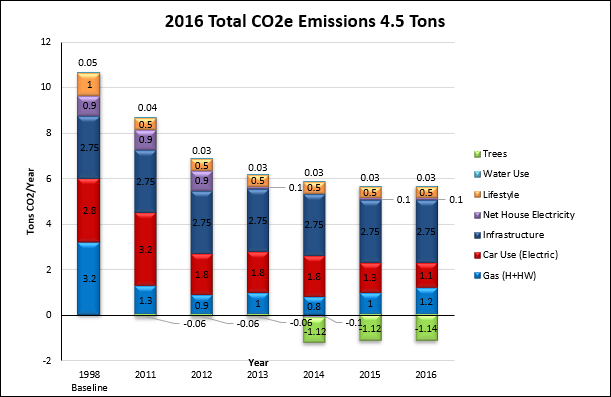
Fig.1. The fingerprint of CO2e emissions in 2016, in comparison with previous years and baseline.
Solar Power Generation
The total solar power generation for the year decreased by 72 kWh to 1541 kWh, derived from reading the generation meter. The monthly solar generation data are shown in Fig.2.
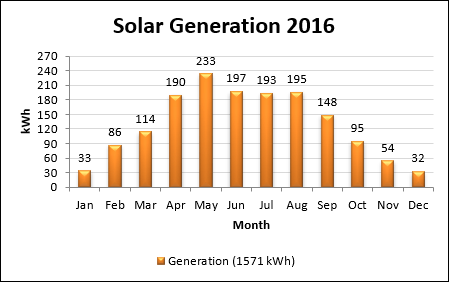
Fig.2. Monthly solar generation data.
Household Electricity Consumption
Total annual household electricity grid consumption was reduced on the previous year by 127 kWh or 9% to 1300 kWh, again derived from reading the electricity meter. The monthly grid electricity consumption data are shown in Fig.3.
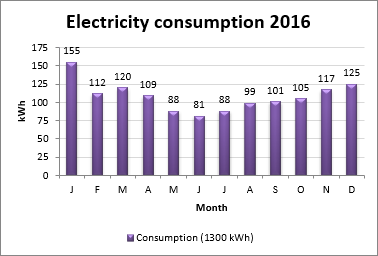
Fig.3. Monthly grid electricity consumption data.
Using the assumption of 25% solar self-consumption, this year, 1300 kWh grid consumption minus 1156 kWh solar export resulted in a net grid electricity consumption of 144 kWh. Grid electricity was given a carbon intensity figure of 0.449 kgCO2e/kWh (DECC, 2016) for a 2016 generation mix. The combined solar self-consumption and exported generation resulted in an emission reduction of 44 kgCO2e to 65 kgCO2e, holding the footprint value at 0.1 tCO2e.
Space and Water Heating
Total annual household gas consumption increased by 20% on the previous year to 5914 kWh, derived from monthly meter readings, shown as a column chart in Fig.4. All consumption was provided by the gas grid, and given a carbon intensity figure of 0.204 kgCO2e/kWh (DECC, 2016). This resulted in an increase of 197kgCO2e to 1206 kgCO2e or 1.2 tCO2e emissions. As the chart shows, this increase was due to a cold start to the year and a cold spring season.

Fig.4. Monthly gas consumption data.
Car Travel
The car in use was a battery electric vehicle (BEV). The annual mileage estimated to the nearest 1000 decreased to 11000 miles, or 18000 km. As the fuel is electricity, the carbon intensity figure of fuel production and use in an electric vehicle is the same as is given for grid electricity, which this year was 0.449 kgCO2e/kWh (DECC, 2016) for a 2016 generation mix. The car consumed 2402 kWh of electricity to charge, derived from monthly readings of the night time consumption meter and shown as a column chart in Fig.5., resulting in fuel production emissions only of 1079 kgCO2e or 1.1 tCO2e.
Note: In the units previously given for vehicle emissions, 2016 grid electricity equates to 0.06 kgCO2e/km.
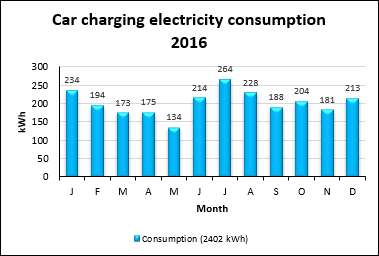
Fig.5. Monthly car charging data.
Water Consumption
Total annual household water consumption was reduced to 30 m3, derived from a utility bill for that year. The 2016 carbon intensity figure of domestic water supply (0.344 kgCO2e/m3), and treatment (0.708 kgCO2e/m3) is given as 1.052 kgCO2e/m3 (DECC, 2016). This resulted in a reduction of 2 kgCO2e to 32 kgCO2e, holding the footprint value at 0.03 tCO2e emissions.
Lifestyle
A small measure taken in this year, was the replacement of a petrol-powered lawn mower with a battery-powered robotic mower, pictured in Fig.6. The new device trimmed the large lawn using stored solar power generated by the rooftop array. The result being this was the last year that I had to purchase any petrol. This did not affect the results in the carbon footprint calculator (WWF, 2016), so emissions remained at 0.5 tCO2.

Fig.6. The robotic lawn mower in its charging station.
Infrastructure
The figure for infrastructure emissions in the carbon footprint calculator (WWF, 2016) remained at 2.75 tCO2 for each UK citizen. Two more trees were planted at home in this year, bringing the total to 14, and together with the annual donation to the Woodland Trust to plant 25 m2 of woodland, will off-set and sequester -1.14 tCO2 of these indirect emissions.
Behaviours
By this year, most of the behavioural changes to affect a more sustainable existence personally had taken place and were being maintained. However, through the charities that I was supporting, I began to be more active in political lobbying of my local representatives, to try to have a wider positive impact on environmental issues, such as climate change and carbon emission reduction. To help promote this, in May I joined Twitter at @EcofuturistUK.
Conclusions
There was an overall emissions reduction of 2% or 0.1 tCO2e compared to the previous year, and 58% or 6.2 tCO2e compared to the baseline year. There were reductions in grid consumption and vehicle travel emissions, in part due to a lower emission factor for grid electricity as more renewable generators were added to the mix. However, these were cancelled out by lower solar generation and higher gas consumption. There was also a slight decrease in water use, which does not show in the fingerprint.The actual difference between the 2015 and 2016 footprints was the 20 kgCO2 sequestered from the planting of two trees, and this resulted in a rounding down of the footprint by the 0.1 tCO2e figure.
References
The Department for Energy and Climate Change (2016). Greenhouse gas reporting – Conversion factors 2016. Available at: https://www.gov.uk/government/publications/greenhouse-gas-reporting-conversion-factors-2016 (accessed January 2017).
WWF-UK (2016). Available at: WWF Footprint Calculator (accessed January 2017).
 The EcoFuturist